The unit price of a clear PET egg tray gets negotiated to the third decimal place. The freight bill that moves it is often accepted as a fact of life, quoted once and paid many times. That habit costs importers real money, because the number of trays that fit in a container is not set by the market or by the carrier. It is set by geometry: the size of the tray, the way nested trays slide into each other, and the size of the carton they travel in. All three are chosen long before a booking is made, which means freight cost is a design decision that most buyers never design.
Packaging is a volume business before it is a weight business
A 40 ft high cube container offers about 76.4 cubic metres of internal space and a payload around 28,600 kg. Empty PET trays are light, so a container full of egg packaging reaches its last cubic metre long before it reaches its weight limit. Carriers sell the box, not the kilogram, and the rate on that box is restless: published indices for a 40 ft container on the Asia to North Europe lane moved in a band from roughly 2,700 to 4,500 USD through 2026, with weekly swings of several percent, and fuel and other surcharges stacked on top of the headline rate. When the rate is that unpredictable, the only number in the equation you actually control is the volume your cargo occupies.
Three numbers decide the load
Every tray has three numbers that matter to a freight forwarder, and none of them is the price. The first is the envelope of the tray, its length, width and height, which is the volume each tray would occupy if it shipped alone. The second is the nested pitch: the vertical distance between two trays in a stack, which is the tray wall thickness plus the small gap created by the denesting lugs that keep stacked trays from locking together. The third is the outer size of the export carton, because the carton, not the tray, is what actually fills the container.
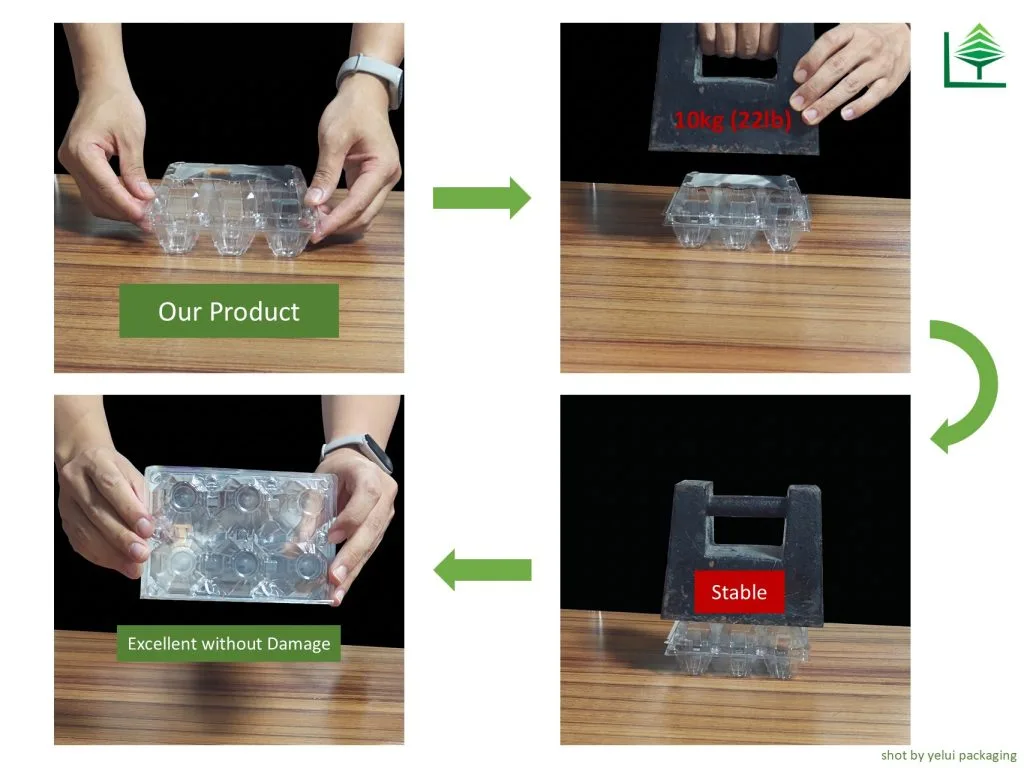
Thermoformed trays are formed on a mould with a draft angle, typically 3 to 5 degrees, so the walls lean inward and the trays nest. The pitch is where the money hides. A widely used rule of thumb in the thermoforming trade says that shaving 2 mm from a 25 mm pitch lifts the number of trays per container by roughly 8 to 9 percent. There is no free tray in that trade: the same pitch that lets stacks separate easily on the packing line also decides how many stacks fit on a pallet and how many pallets fit in the box.
A worked example from our own catalogue
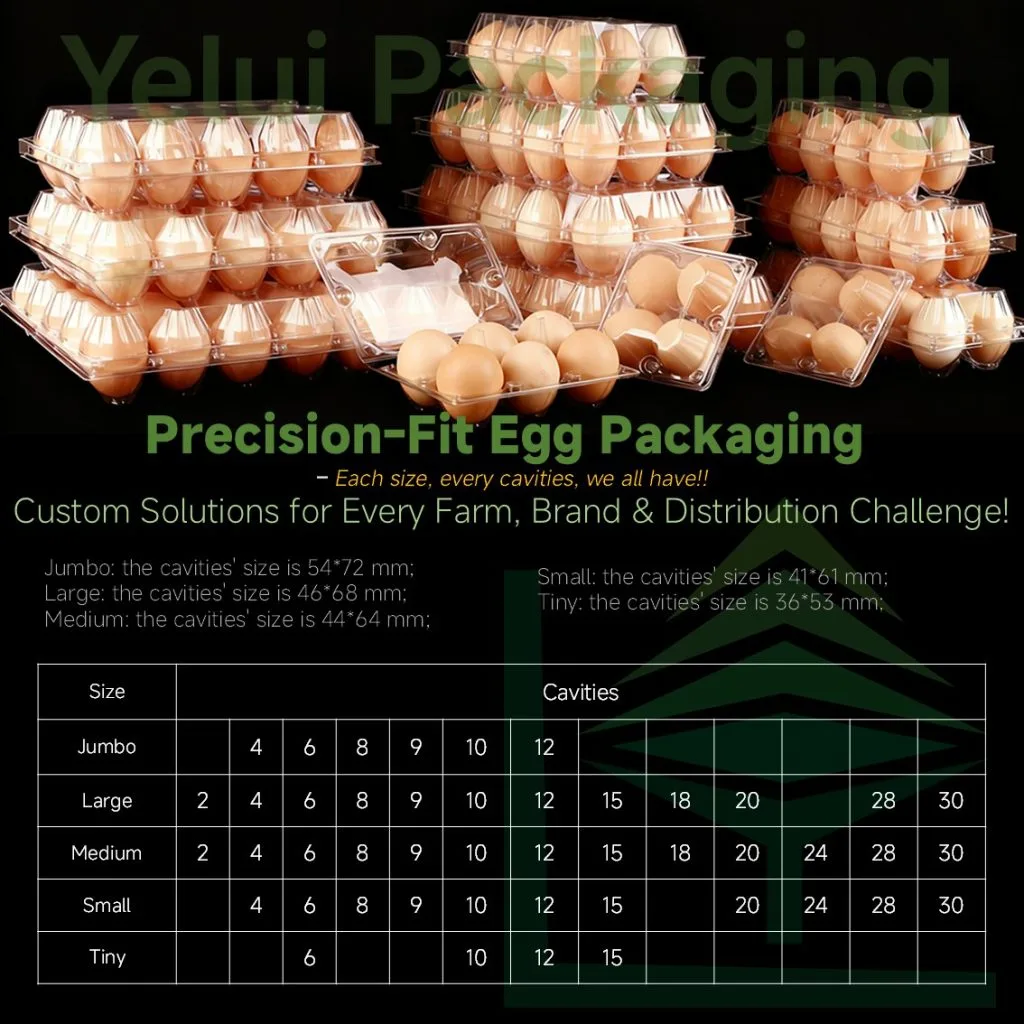
Take three real products. The Q12 quail egg tray measures 140 by 105 by 40 mm, an envelope of about 0.59 L for 12 eggs, close to 49 mL of shipping volume per egg. The Q24 quail egg carton measures 198 by 132 by 40 mm, about 1.05 L for 24 eggs, or roughly 44 mL per egg. The L12X3 large egg tray measures 150 by 200 by 68 mm, about 2.04 L for 12 eggs of 65 to 75 g, or 170 mL per egg. Two Q12 trays carry the same eggs as one Q24, but occupy about 1.18 L against 1.05 L, some 11 percent more volume for the same eggs. Move up the pack size and the freight per egg falls before a single price has been negotiated.
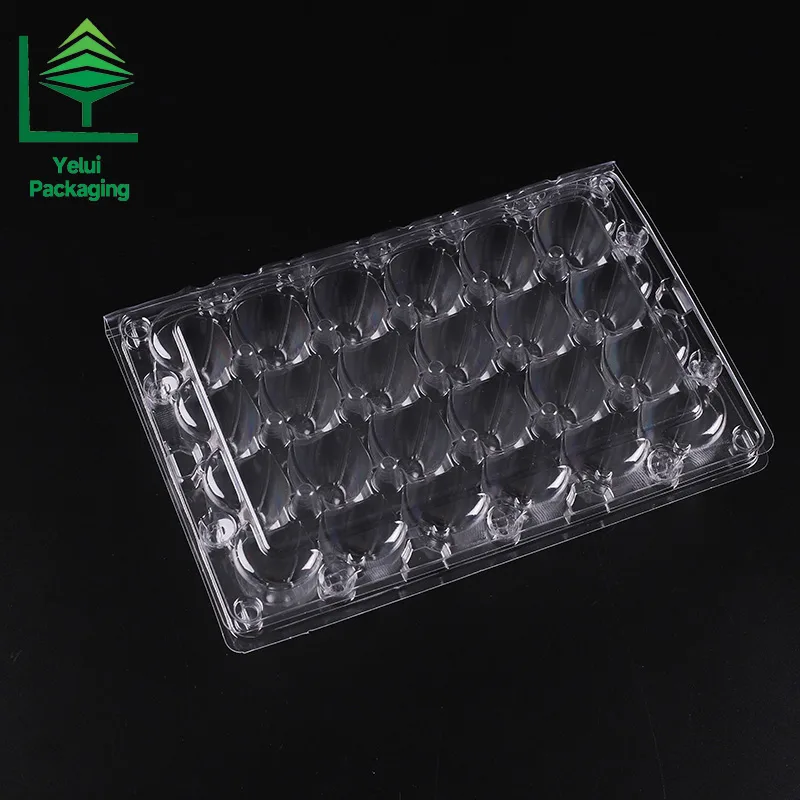
These envelopes are not the shipped volume, and that is the point. Nested stacks pack trays at a fraction of their envelope, so the number that matters is the packed volume of a full carton: the trays per carton, laid out in columns, at the nested pitch. Ask the supplier for the outer carton dimensions and the trays per carton, and the arithmetic takes one line. Our product pages list trays per carton for every SKU, for example 1,200 pieces for the Q12 and 540 pieces for the L12X3.
Pallets, the other rectangle
Between the carton and the container sits the pallet, and the pallet has opinions. A European pallet measures 1200 by 800 mm and a North American GMA pallet measures 1219 by 1016 mm; a 40 ft high cube takes 25 Euro pallets per tier or 21 of the American size. A tray that misses the pallet module by 20 mm can push a whole column of cartons off the pattern, and the wasted strip repeats on every layer. It is worth checking that the tray footprint, rotated if needed, tiles the destination pallet without dead space, especially if the same SKU ships to both Europe and the United States.
From volume to money
The last step is one division. Suppose a load plan reaches 400,000 nested quail trays in a 40 ft high cube and the ocean leg is budgeted at 4,000 USD. The freight adds one US cent per tray. If a poorer pitch cuts the load to 200,000 trays, the same bill adds two cents, and on a tray priced at 5 US cents that is a 20 percent jump in landed cost, larger than most discounts buyers win at the negotiating table. Full containers are billed per box, so every tray added to the same box travels nearly free; less than container loads work the other way, charged per cubic metre, and the usual industry rule of thumb puts the breakpoint between 15 and 18 cubic metres, below which consolidating is cheaper and above which a full container wins. Quote both whenever a shipment sits close to the line.
What to ask before you confirm an order
- Ask for the outer carton dimensions and the trays per carton for every SKU, not only the unit price.
- Ask whether the carton plan tiles your destination pallet, Euro or GMA, without overhang.
- Ask for the nested pitch and whether it can be tuned to your packing line.
- Ask for a mixed SKU container plan if one item alone does not fill a box.
- Requote freight close to booking, because index rates move week by week.
The buying process behind these questions, from sampling and tooling to payment terms and shipping documents, is laid out in our guide to sourcing blister egg trays from China.
Quick answers
How many egg trays fit in a 40 ft high cube container?
There is no single answer, but there is a formula: take the usable container volume, roughly 60 to 70 percent of 76 cubic metres for cartoned cargo, divide it by the packed volume of one carton, and multiply by the trays per carton. Weight almost never limits a load of empty PET trays; volume does.
Is it cheaper to ship trays nested or assembled?
Nested, in almost every case. A nested stack carries several times the trays per cubic metre of an assembled pack, which is why nested designs dominate export packaging. The cost is a denesting step on the packing line, and for ocean shipments that step is nearly always worth it.
Does a lighter tray always cost less to ship?
No. A full container is billed per box rather than per kilogram, so a gram saved on the sheet does not reduce the ocean bill. Weight matters for consolidated cargo and air freight, and a thinner sheet can also weaken the stack. Choose thickness for the packing line and the retail shelf, and choose geometry for the freight. The material basics are covered in our introduction to blister packaging.
Freight is not a tax on buying packaging. It is a second product, built from the same drawings, and the buyer who treats pitch, carton and pallet as design inputs pays less for every tray that leaves the factory. Browse the full range of clear PET egg trays and counts in our products section, or send us your destination port and pack counts and we will return a load plan with the carton dimensions included.
Cathy Zhou writes about export logistics and retail packaging for the Yelui Packaging team.