Blister packaging is the name the packaging trade gives to a family of formats made by heating a sheet of thermoplastic until it softens, then drawing that sheet down over a mold so it copies the shape of whatever it will hold. The outcome is a rigid tray with pockets cut to the product, whether that product is a single egg, a set of drill bits, or a sealed dose of tablets.
The name comes from the raised pocket itself. In older pharmaceutical work the dome over each tablet was called a blister, and the term stuck to every tray built the same way. Today the same process produces egg trays, hardware inserts, medical device cradles, retail clamshells and protective liners, all from one principle: shape the plastic around the product instead of padding the product inside a box.
What counts as blister packaging
Three formats get grouped under this heading, and buyers often mix them up. Getting the terms straight matters when you write a specification, because each one carries different tooling and different cost.
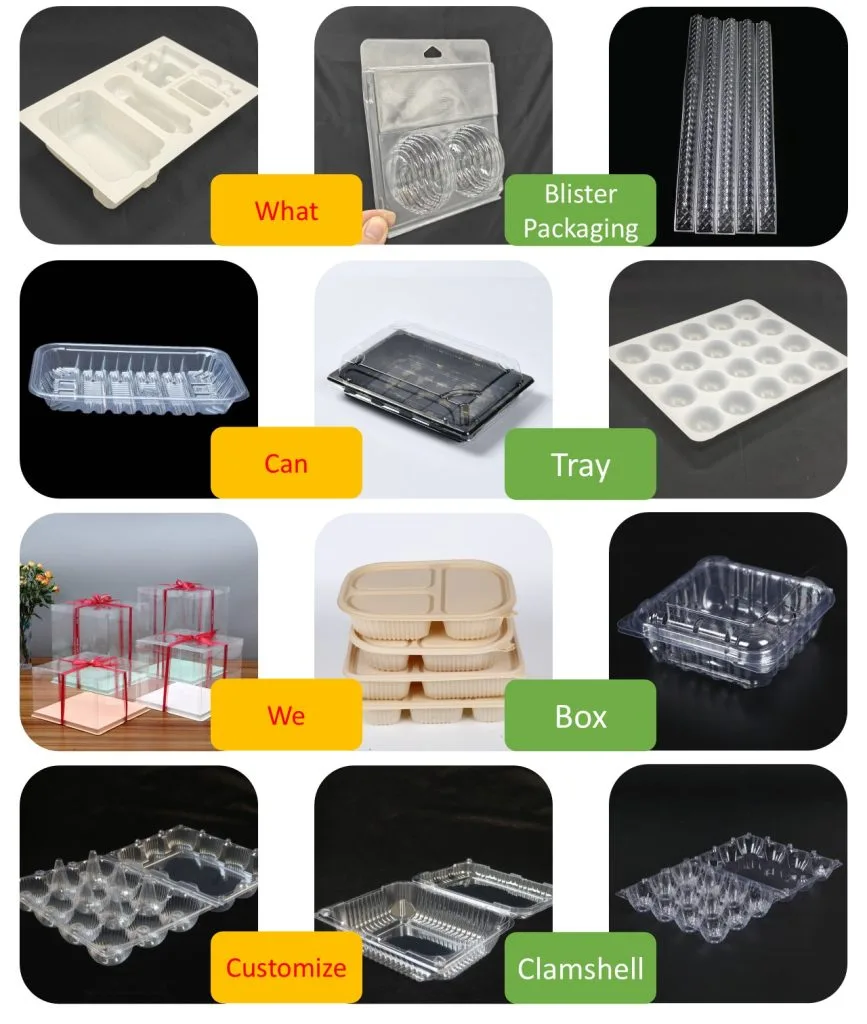
- Blister or cavity tray. A flat sheet formed into shallow pockets, usually open on top. Egg trays, quail egg trays and hardware inserts belong here. The product sits in the pocket and the tray stacks.
- Clamshell. Two halves formed from one sheet and hinged along a fold line, so the pack closes on itself. Retail electronics and food service use this style when the product needs to be visible and enclosed.
- Skin packaging. The product sits on a card and a softened film drapes directly over it. There is no cavity, so odd shaped items stay put without a custom mold.
The common thread is vacuum thermoforming. Once you understand that process you can judge any of the three on tooling cost, material choice and lead time.
The four materials buyers actually choose between
Material decides how the tray performs, how it is regulated and how it is disposed of. Four polymers cover most orders.
- PET and recycled PET. Clear, strong and widely recycled. This is the default for food contact trays such as egg packaging, and it is the material we mold most. Recycled PET that meets food contact rules is available under approved processes in both the EU and the US.
- PVC. Cheaper and easy to form with sharp detail, but it carries a poor recycling profile and is being pushed out of food packaging in several markets. Buyers still specify it for hardware and non food consumer goods.
- PS and HIPS. Low cost and stiff, with limited clarity. Common for industrial inserts and disposable trays where transparency is not needed.
- PP. Higher heat resistance and good chemical resistance, so it suits trays that see hot filling or repeated washing. Less transparent than PET.
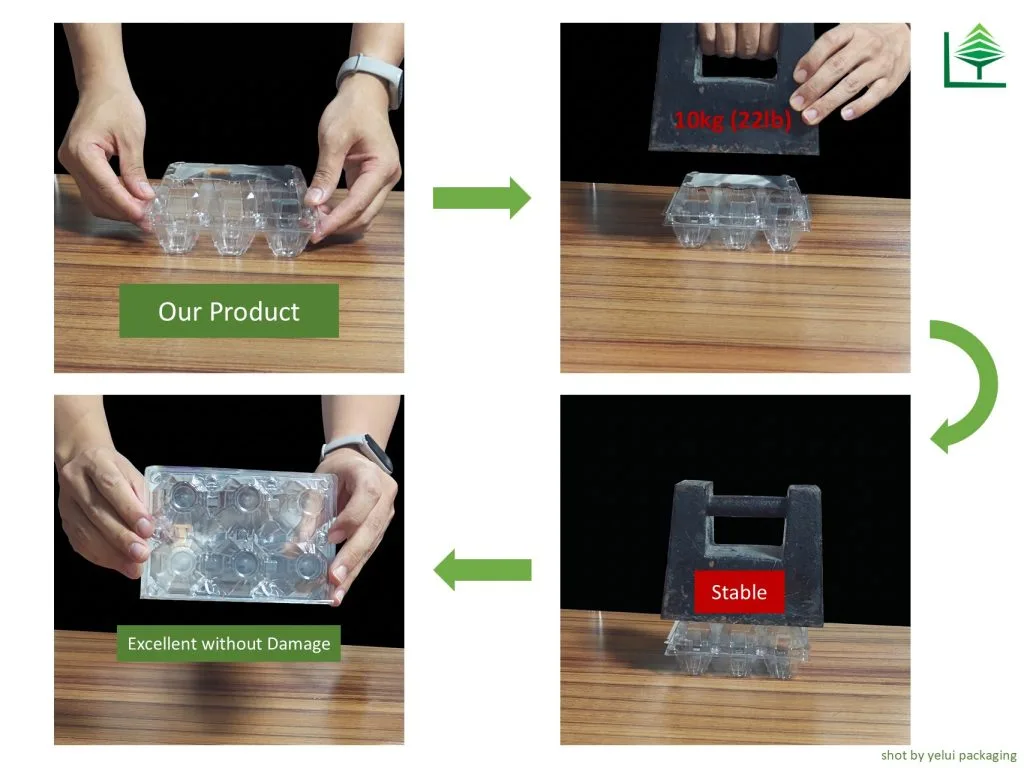
Sheet thickness usually runs from 0.3 mm to 1.5 mm. Thin gauges save material and cost, thick gauges hold heavier loads and resist flexing when a full tray is lifted by one corner. For a stacked egg tray carrying 30 eggs, the wall section matters more than most buyers expect, because a tray that bows under load breaks eggs on the pallet.
How a blister tray is made: the vacuum thermoforming cycle
Vacuum thermoforming uses air pressure and a mold to turn a flat sheet into a shaped tray. The cycle runs in five stages.
Mold fabrication
A mold is produced from gypsum, carved wood or machined metal, matched to the product dimensions. Gypsum molds are dried, then drilled with micro vents of 1 to 2 mm at the deepest points of each cavity so air can leave as the sheet is drawn down. Extra vents around the perimeter of the tray let the vacuum chamber pull evenly. The mold is then saturated in a concentrated alum solution to harden the surface so it survives repeated cycles.
Metal molds cost more up front but hold tolerance far longer, which is why they are used for long production runs.
Sheet preparation
Thermoplastic sheet is cut to match the mold footprint and clamped into a frame so it cannot shrink away from the mold as it heats. Clamping pressure and frame design decide whether the finished tray has even wall thickness or thin corners.
Heating
The clamped sheet moves into a heating station where radiant heaters bring it to its softening range. Temperature and dwell time are set by polymer and thickness. Too cool and the sheet will not draw into the deepest cavity. Too hot and the wall thins until it tears.
Forming
The softened sheet is positioned over the mold inside a vacuum chamber. Air is evacuated and atmospheric pressure pushes the pliable sheet into every cavity, so it takes the mold contour. Some molds also use a plug to pre stretch the sheet into deep pockets before vacuum is applied. The formed tray cools against the mold and sets.
Trimming and inspection
The tray is demolded and trimmed to remove the web between cavities, then inspected for wall thickness, cavity dimensions, cracks at the corners and clarity. Trays that fail are reground where the material allows it.
Every step is a variable that can be tuned for the product, which is why a good supplier asks about the item going into the tray before quoting a price.
Blister packaging compared with molded pulp
For egg packaging the real choice is usually between clear PET and molded pulp. Both protect eggs, but they do different jobs.
- Visibility. PET is transparent, so buyers and inspectors see the product without opening the pack. Pulp hides it.
- Print and branding. Pulp takes ink directly. PET needs a label or a printed sleeve, though the tray itself can be molded with logos and lot codes.
- Protection from moisture. PET does not absorb water and cleans easily, which matters for food handling. Pulp breathes.
- Recycling. Clear PET has an established recycling stream in most export markets. Molded pulp is compostable and biodegradable but is not always accepted in kerbside recycling.
- Cost. Pulp is often cheaper per unit at low volume. PET becomes competitive once mold cost is spread over a larger run.
We compared the two in detail in our guide on clear PET and molded pulp egg cartons, including which markets favor which.
Where blister packaging is used
The formats show up wherever a product needs to be held, seen and protected at once.
- Eggs and quail eggs. Trays from 6 to 30 cavities hold eggs in fixed positions so they travel without knocking together. Small formats for quail eggs are molded to their own cavity geometry rather than scaled down from a chicken egg tray.
- Hardware and tools. Drill bit sets, fasteners and spare parts ship in formed inserts that keep each item in place on a shelf.
- Medical and pharmaceutical. Blister packs protect sterile devices and unit dose medicines, with sealed lidding film over each cavity.
- Consumer electronics. Clamshells and trays hold small devices and accessories for retail display.
- Food service. Trays for bakery items, produce and prepared food, often designed to stack and to vent.
Our own product range covers the egg and small format end of this list, from 30 count chicken egg trays down to 6 cavity quail egg trays. You can see the full catalogue on our products page.
What to specify when you order
A clear specification shortens quoting and prevents rework. Bring these to the conversation.
- Product dimensions and weight. Cavity size is built from the item, so a millimeter in the wrong direction means a new mold.
- Cavity count and layout. How many items per tray, and how the rows divide, affects stacking strength and carton size.
- Material and gauge. PET, rPET, PVC, PS or PP, and sheet thickness.
- Stacking load. How many filled trays sit on the bottom one in a carton and on a pallet.
- Printing and branding. Embossed logos, lot codes, or a printed sleeve.
- Compliance. Food contact rules for the destination market, and any recycled content target.
- Volume and schedule. Order quantity drives mold choice and unit price.
Frequently asked questions
Is blister packaging recyclable?
It depends on the polymer. Clear PET is the most widely recycled and is accepted in most municipal streams, which is one reason it dominates food trays. PVC and mixed material packs are far harder to recycle. If recyclability is a requirement in your market, specify a single material and avoid lidding films that cannot be separated.
What is the difference between a blister and a clamshell?
A blister tray is a single formed sheet with open cavities. A clamshell is formed from one sheet as two halves joined by a hinge, so the pack closes around the product. Clamshells usually need more material and a larger mold, but they enclose the product without a separate lid.
What is the minimum order for custom blister trays?
It depends on the format. Carton packed trays such as our egg trays start at 3 cartons with a lead time of 1 to 2 weeks. Bag packed formats run from 10,000 pieces with 3 to 4 weeks. Tooling and sampling sit outside these minimums, and a sample tray is worth ordering before committing to a production run so you can test fit and stacking. Our blister egg packaging FAQ covers the questions that come up most often at this stage.
The short version
Blister packaging shapes plastic around a product rather than padding a product inside a box. It gives visibility, fixed positioning and light weight at low material cost, and it is produced by vacuum thermoforming, a process with five tunable stages from mold to trim. The material you choose decides the regulatory path and the end of life story, and clear PET remains the practical default for food contact trays. If you are sourcing trays for eggs or small items, the two things worth pinning down first are cavity geometry and stacking load, because those drive both the mold and the carton.