
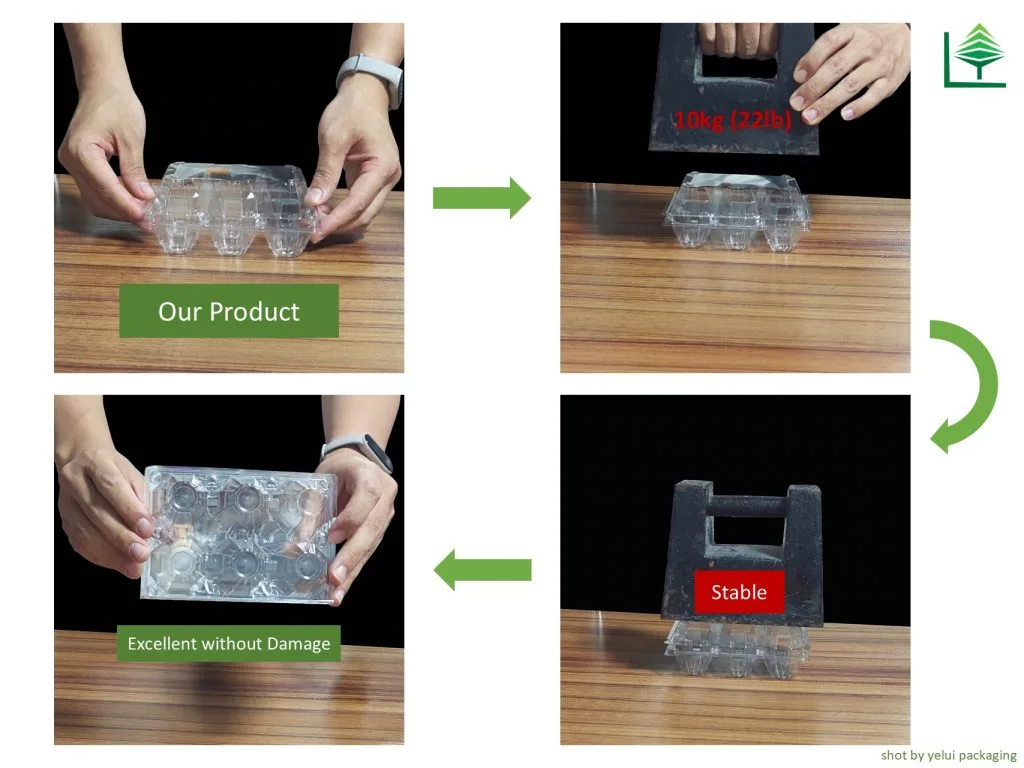
A container of clear PET egg trays arrives, the seal is cut, a buyer opens two cartons at the top of the pile, sees transparent plastic that looks like the sample, and signs. Weeks later the packing line jams because the trays lock together, or a retail buyer rejects a batch because corners split under stacking. The gap between a good sample and a good shipment is closed by a sampling plan, a written defect list and an agreed way to handle a failed lot; the packaging trade has a standard vocabulary for all three.
Why a sampling plan beats an open carton
Checking a handful of trays feels diligent but proves little: in 30,000 trays, a defect present in 3 percent of the units can hide from an unstructured look. The industry answer is acceptance sampling, defined in ANSI/ASQ Z1.4, the American edition of ISO 2859 part 1. The standard answers two questions with tables instead of opinions: how many trays to pull from the lot, and how many defects are allowed before the lot is rejected. Inspections are usually booked when all goods are produced and at least 80 percent are packed.
Three defect classes, translated for an egg tray
The standard sorts defects into critical, major and minor, and the classification must be agreed in writing before production starts. A factory and a buyer will not naturally agree on whether a scratch on a clear tray is major or minor, and a decision made on inspection day is made under pressure. For a blister egg tray the classes look like this:
- Critical defects, accepted in zero quantity. Anything that could harm a consumer or break a food contact rule: mould or insect fragments inside a tray, a sharp flash spike on the trim line, a cavity punctured through, or sheet that is not the agreed food contact grade. One critical defect rejects the whole lot.
- Major defects, the functional failures. Cracked or split trays, cavities deformed so an egg sits loose or wedges tight, webbing between cavities that stops trays nesting, stacks that lock on the packing line, dimensions outside tolerance, or a handle that fails its first opening.
- Minor defects, the cosmetic ones. Light chill marks, small scuffs, slight haze inside an agreed limit, a trim nib below the defined size. A shopper may notice them, but the tray still does its job.
Each class carries its own acceptance number. The default for consumer goods in most inspection programs is zero for critical, 2.5 for major and 4.0 for minor, written as AQL 0 / 2.5 / 4.0. A purchase order that says only AQL 2.5 is ambiguous, so all three numbers belong on the PO.
Reading the table: a worked example
Suppose the lot is 30,000 trays. Under General Inspection Level II, the default for most pre shipment checks, a lot of 10,001 to 35,000 units maps to code letter M and a sample of 315 trays. At AQL 0 / 2.5 / 4.0 the lot passes with no critical defects, up to 14 major defects and up to 21 minor defects in the sample. The fifteenth major defect, or the first critical one, rejects it.
The standard also contains switching rules. If two lots out of five consecutive lots fail, the next shipments move to tightened inspection, which shrinks the acceptance numbers; five consecutive passes bring the plan back to normal. The buyer only has to name the level and the three AQL values.
Defects that come with the thermoforming process
Most forming defects trace back to five sources: uneven sheet heating, weak or late vacuum, insufficient forming pressure, moisture in the material and tooling condition. Each leaves a visible signature:
- Webbing and bridging: folds of excess material between cavities or across corners, usually where the sheet ran too hot. Webbing also invites stacked trays to lock, which is a line stop. The nesting mechanics are covered in our article on denesting design for packing lines.
- Thin corners: corner walls form last and cool first, so a slow vacuum leaves them translucent and weak. They pass a glance and fail a stack test.
- Blisters and bubbles: raised bubbles on the surface, the classic signature of moisture in PET sheet that was not dried before forming.
- Chill marks and stress whitening: white or wavy patches where hot sheet met a cold mould, or cloudy bands from stretching below the forming window.
- Poor detail and pinholes: soft ribs, faint embossing or tiny punctures at the deepest draw points, pointing at blocked vents or leaking vacuum lines.
Visual checks are backed by instrument tests on a measured subset: wall thickness at defined points, cavity pitch and envelope against the drawing, and a stacking or load test. How those tests are designed is laid out in our guide to testing a tray before you buy, and the process causes behind most of these defects are explained in our walkthrough of how a clear PET egg tray is made.
Freeze the reference before production
An acceptance plan measures the shipment against something, and that something must exist on paper before the first shot is formed: a signed golden sample kept by both sides, a drawing with tolerances, and a defect list with photographs that pins every borderline case to a class. The tables tell an inspector how many trays to check; only the defect list tells the inspector what counts as a defect for this tray. A buyer who skips the list is buying an argument at the factory gate.
It is equally important to know what the plan does not promise. Passing an AQL inspection means the sample met the agreed limits; it does not mean the lot is defect free or that the next lot will pass. Sampling is a gate, not a quality system, which is why the same defect tends to return unless the findings are fed back to the forming line.
What to do when a lot fails
A rejected lot leaves three exits. Rejection is the cleanest and the most expensive. Sorting means the factory screens 100 percent of the lot, removes defective units, and the shipment is re inspected against the same plan. A concession, accepting the lot at a documented discount, only makes sense for minor defects and never for critical ones.
Who pays is decided by the contract, not by the inspection report. Industry practice is that a supplier whose lot fails on its own defects carries sorting, rework and re inspection, but that convention only protects the buyer if it is written into the purchase order alongside the AQL values, the inspection level and the named standard. The clause should also say what evidence a claim needs: the report with photographs, retained samples and defect counts by class.
Quick answers
What AQL should I set for clear PET egg trays?
The common default is AQL 0 / 2.5 / 4.0 for critical, major and minor defects at General Inspection Level II. Buyers with automated packing lines or premium retail shelves often tighten the major class to 1.5, because a tray that jams a denester costs more than any inspection. Critical defects stay at zero in every configuration.
Can I inspect 100 percent of the trays instead of sampling?
Full screening of a 30,000 piece lot is rarely economic and suffers from fatigue, so inspectors still miss defects late in a shift. Sampling with a defined plan gives known statistical confidence at a known cost. Reserve 100 percent checks for sorting a failed lot or for a feature with no tolerance, such as foreign matter.
Who pays when a shipment fails inspection?
Whatever the purchase order says, which is why the AQL values, the inspection level and the cost clause must be in writing before production. The usual convention is that a supplier whose lot fails on its own defects carries sorting, rework and re inspection. If the defect list was never agreed, expect a negotiation instead of a rule. The commercial groundwork is summarised in our blister and egg packaging FAQ.
Inspection is not a test of trust between a buyer and a factory. It is a shared language: three defect classes, one sampling table and a defect list both sides signed. A buyer who brings that language to the first order gets fewer disputes and fewer stopped lines. Browse the full range of clear PET egg trays in our products section, or send us your cavity counts and target market and we will quote with the golden sample, drawing and defect list included.
Kevin Zhao writes about quality control and export operations for the Yelui Packaging team.