
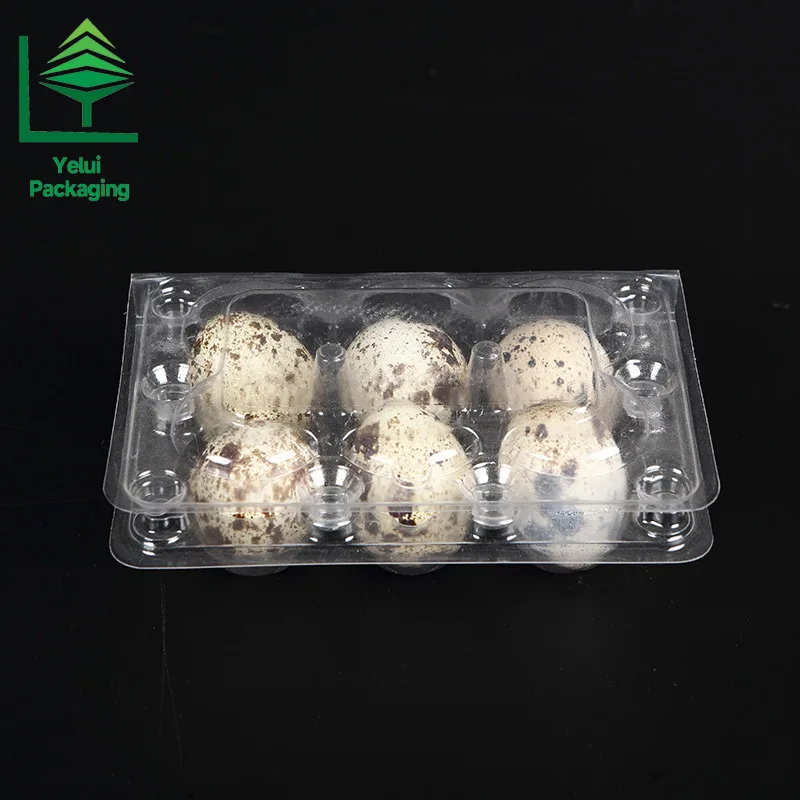
Every buyer of clear PET egg trays learns to read a price per thousand. Very few learn how the tray in their hand was actually made, even though the forming line decides most of what a buyer later complains about: how a tray stacks after a long sea voyage, whether a cavity wall holds under a full pallet, and why one shipment feels crisp while the next feels soft. A tray is not moulded from a liquid. It starts as a flat sheet, and every quality difference you can feel is a record of how that sheet was heated, stretched and cooled.
The tray starts as a flat sheet, not a liquid
Thermoforming is easy to describe and hard to do well. A flat sheet of rigid PET is clamped in a frame, carried into an oven, heated until it softens, then pushed or pulled against a mould and held until it is cool enough to keep the shape the tool gave it. Nothing is injected, and nothing melts into a free flowing liquid. Packaging work almost always uses thin gauge material, defined in the trade as sheet under about 1.5 mm.
The sheet arrives from an extrusion line where molten polymer is cast onto a chilled roll and cooled so fast that the polymer chains never organise into crystals, because crystals scatter light. For the wider family of shapes made the same way, see our introduction to blister packaging.
Gauge is the first decision and the last one buyers check
Sheet suppliers commonly quote about 0.25 to 0.5 mm for food trays. The gauge on the purchase order is not the thickness in the finished tray. Forming stretches the sheet, and industry references put the reduction across a formed part between 20 and 50 percent, concentrated at the deepest points of the cavities and at the corners where the sheet turns most sharply.
This is why two trays formed from the same gauge can behave completely differently. One carries its load, and the other hides a thin ring inside a cavity wall where no buyer will ever see it.
Heat is where tolerance is won or lost
Every thermoplastic has a forming window rather than a single forming temperature, and the sheet has to reach an even temperature through its full thickness. A sheet that is too cold resists stretching, shows pale whitening along the draw lines and can tear at a corner. A sheet that is too hot becomes fluid, sags under its own weight and stretches unpredictably.
Sag steals material from exactly the wrong place. A sagging sheet pools polymer in the lowest part of the cavity before the mould does any work, so the walls form from whatever is left above it. Trade sources place the useful forming range for PET broadly between about 120 and 160 degrees Celsius, and holding a window that narrow means controlling the heaters zone by zone.
Why deep cavities thin out, and what a plug does about it
Draw ratio compares the depth of a formed part with the smallest distance across its opening. Practical limits for trays sit close to 1 to 1, though tooling engineered with pre stretch can reach toward 2 to 1 with certain materials. A tray with shallow, wide pockets is a comfortable draw. A tall tray with narrow pockets is not.
The standard remedy is a plug, a machined male form that enters the heated sheet and pushes material down into the cavity before vacuum is applied. The plug does not create material, it moves it. By carrying polymer toward the sides instead of letting vacuum pull everything straight down to the base, it produces a more even wall. Trade references describe plugs travelling to roughly 50 to 70 percent of cavity depth, and studies credit plug design with reducing thickness variation by up to about 30 percent against vacuum alone. Plug temperature matters as much as shape: a cold plug leaves chill marks, while an overheated one sticks and drags lines.
Draft, venting and the variables that hide
Two details of the mould never appear in a photograph of a tray. The first is draft, the slight taper built into the walls so the part releases. Because plastic shrinks as it cools, a completely vertical wall grips the tool. Male moulds typically carry 3 to 5 degrees of draft and female moulds need less, usually 1 to 3 degrees. The second is venting. Air at the bottom of a deep pocket has to escape somewhere, and with no path out it compresses into a dome exactly where the sheet should be pressed tightest against the tool. Small vent holes at the deepest points, commonly 0.4 to 0.8 mm, let the sheet take full detail of the cavity.
Two material variables hide the same way. PET absorbs water from the air, and water still inside the sheet at forming temperature turns to steam within the wall, leaving a blister that stays invisible until a tray is cut open. Drying guidance for PET sits at roughly 150 to 160 degrees Celsius for four to six hours, down to about 0.01 percent moisture. Recycled content raises the stakes rather than lowering them, because post consumer PET usually carries more moisture and a slightly lower molecular weight. Regrind changes how the sheet absorbs heat, and a shift in the regrind ratio is a common reason a defect appears between two lots carrying identical paperwork.
What this means when you are buying
Wall thickness at the deepest point of the cavity is the number worth requesting, because it is what the load path sees. Gauge is an input and wall thickness after forming is the result, so a supplier who quotes both is measuring their own process. Ask how the plug is set up for your cavity geometry, ask whether the sheet is dried to a documented schedule, and ask for a wall thickness tolerance rather than one nominal figure.
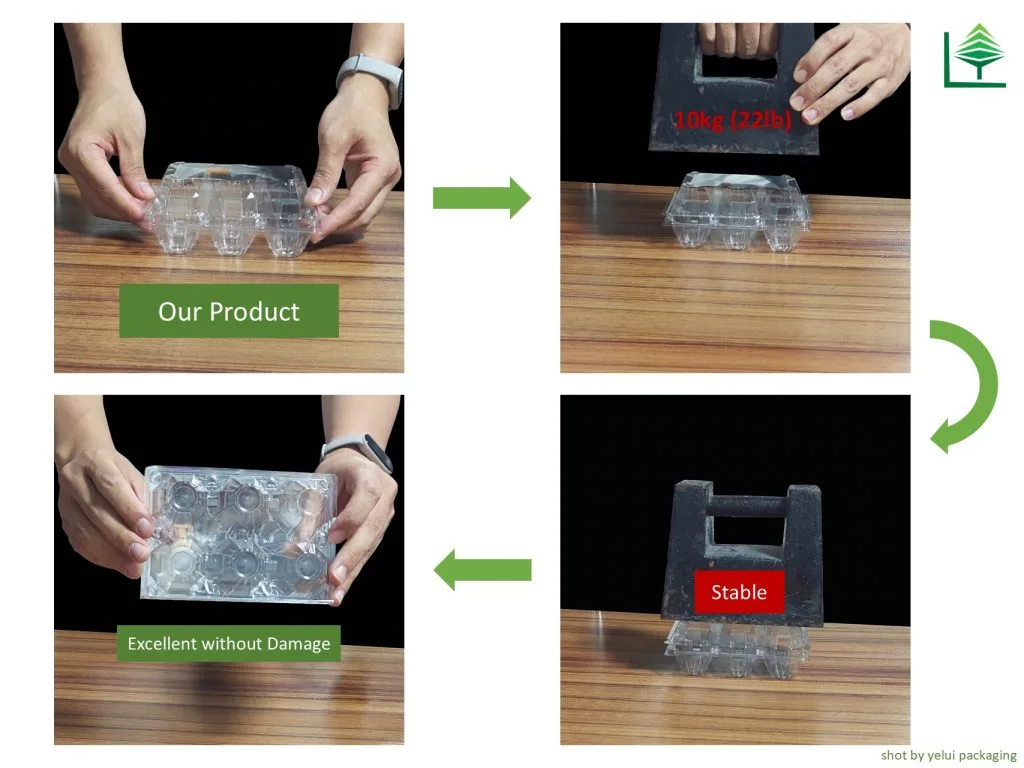
Then check a sample. Weigh a tray, because two trays that differ visibly in mass at the same stated gauge usually came off different settings. Cut one through a cavity and look at the wall. A wall that is even from rim to base, with no pale streaks along the draw, is the visible signature of a stable forming window. Whether the tray then survives the journey is covered in our guide to egg breakage in transit and tray testing.
Quick answers
What sheet thickness is used for clear PET egg trays?
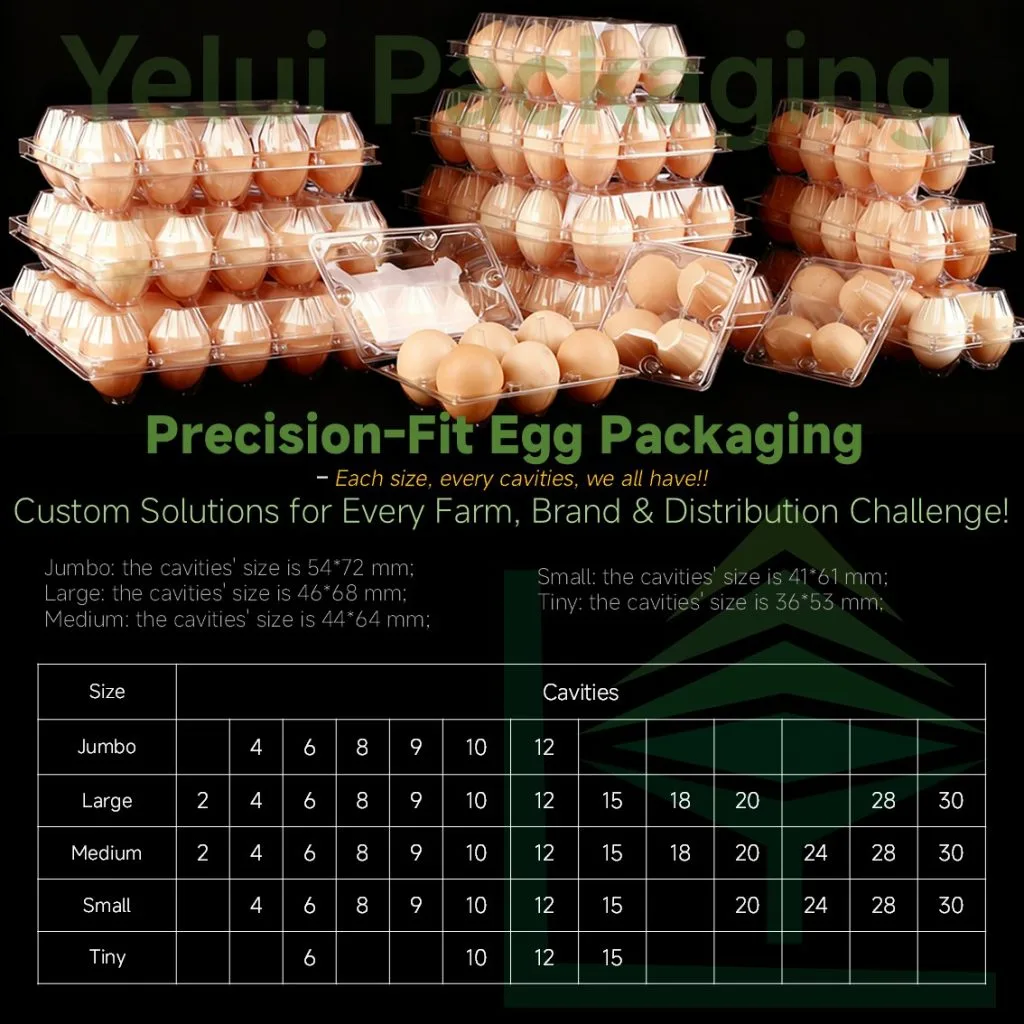
Most food trays are formed from sheet in the 0.25 to 0.5 mm band, and egg trays sit in the middle of that range. The right figure depends on cavity depth, cavity count and the stacking load the tray has to carry. A supplier should be able to explain why a given gauge suits your cavity geometry. Related questions are collected on our blister and egg packaging FAQ page.
Does a thicker sheet always make a stronger tray?
No. Strength comes from wall thickness at the points that carry load, and wall thickness is decided by how evenly material was distributed during forming. A heavier sheet formed with a poorly tuned plug and uneven heating can end up with thinner walls at the cavity base than a lighter sheet formed inside a well controlled window.
Can recycled PET be used for food contact egg trays?
Yes, provided the material and the process are qualified for it. In the European Union, recycled PET intended for food contact must come from a process authorised under Regulation (EU) 2022/1616. In the United States, the usual route is a letter of no objection from the FDA. Buyers should expect documented evidence rather than a promise in an email.
Clear PET egg trays look simple because the process is designed to hide its own difficulty. The sheet, the heat, the plug and the mould all leave their marks in the walls, and those marks decide whether a pallet arrives intact. Browse the tray counts and cavity sizes in our products section, or send us your pack count and destination and we will tell you which gauge and cavity geometry the job needs.
Kevin Zhao writes about manufacturing, sourcing and export practice for the Yelui Packaging team.