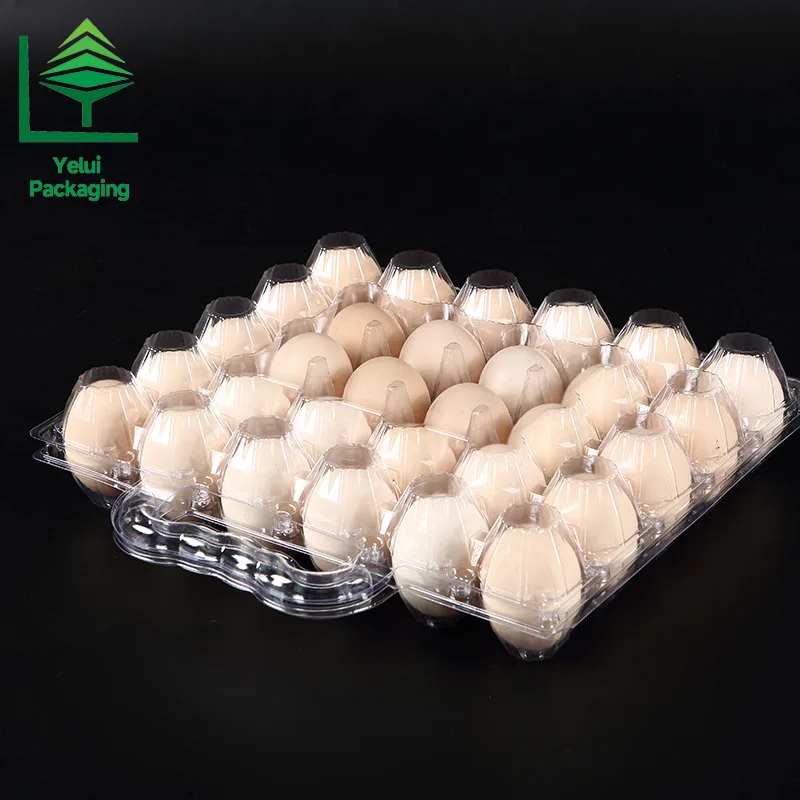
Most buyers who ask for custom egg trays are really asking for one thing: their own name on the pack. It is the only part of the order a shopper will consciously read, and the part that turns an ordinary food contact article into a compliance question, because ink on a pack that surrounds eggs is judged by the same rules as the pack itself. Two decisions settle most of what follows: where the ink may sit, and whether the mark is still legible at the shelf.
Start with where the ink is allowed to sit
A closed egg tray has two faces, and only one may carry printed ink: the outside of the lid, never the inner surface.
The reason is not a legal formality. An egg shell is porous, and a closed tray holds a small volume of air around the eggs for weeks, so anything volatile the ink releases has time to move through that air and into the shell. Three routes carry ink components toward the food: set off transfer, where a printed face touches the food contact face of the next tray in a stack; diffusion through the material itself; and gas phase transfer through the headspace.
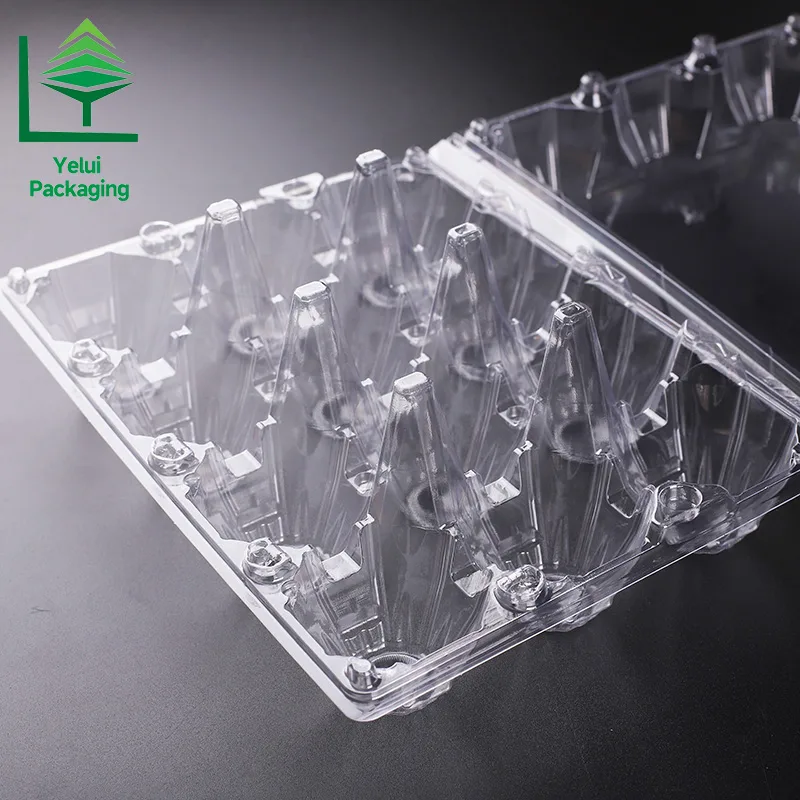
On a clear PET tray the geometry helps. The lid is the flattest and largest surface, and the furthest from the eggs.
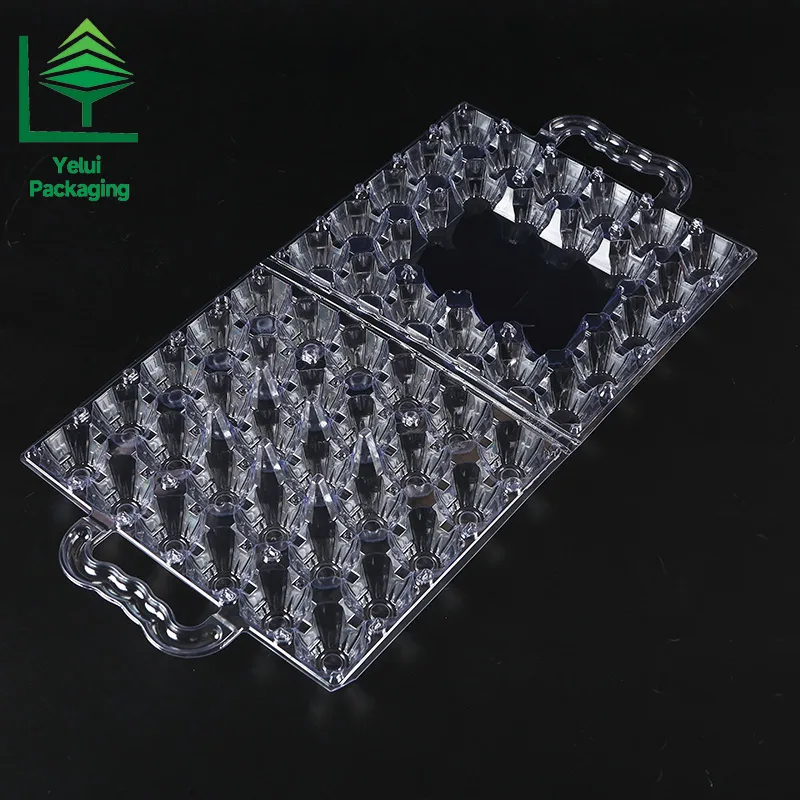
Four production routes for a logo
Pre print on the flat sheet. The roll is printed first and formed afterwards, which is the cheapest route at high volume and gives the sharpest registration, because the sheet is flat and stable when the ink goes down. Forming then stretches the print, so artwork has to be pre distorted, and the correction differs from the rim of a cavity to its base. The ink also has to survive the oven, where sheet temperatures sit broadly between 120 and 160 degrees Celsius.
Pad printing. A soft silicone pad lifts ink from an etched plate and presses it onto the finished tray. It handles curvature a flat press cannot, the tooling is inexpensive, and one to four colours is a normal range. The printed area is small, which suits a logo and a short line of text.
Screen printing. Ink is pushed through a mesh, leaving a thick film that stays opaque even on clear material, which makes it the strongest option for one bold colour on transparent PET. Speed is low, and each tray shape needs its own fixture.
Digital printing. UV cured inkjet puts the design straight onto the formed tray with no plate and no screen. Nothing is charged for artwork setup, so it is the only route that makes sense for a few thousand pieces or for lot codes, at the highest cost per piece.
Labels and sleeves are a fifth answer
Not every logo has to be printed on the tray. A self adhesive label or a printed sleeve carries the graphic and the mandatory text while the tray underneath stays unprinted, so the artwork can change without touching a mould, a plate or a screen and the ink never shares air with the eggs. The wording that must appear on the pack is covered in our guide to egg carton labelling rules.
Adhesion on PET is not automatic
PET is smooth, non absorbent and chemically inert, which is good for eggs and awkward for ink. Ink wets a surface only when the plastic has more surface energy than the ink has surface tension, and untreated PET sits near or below that threshold.
The usual remedy is corona or flame treatment, an electrical discharge that oxidises a very thin layer of the surface and adds polar groups. Treating PET commonly lifts it to roughly 46 to 50 dynes per centimetre, above the 38 to 42 dynes per centimetre that most printing processes ask for. Printers verify the result with a dyne pen, following DIN ISO 8296 or ASTM D2578, before a run starts.
Two consequences follow. Treatment is not permanent, so treated sheet and treated trays should be printed within a short window. And it is easily undone by contamination: mould release agent, dust, fingerprints and slip additives all pull adhesion back down. The proof is a test, not a promise. The standard check is a cross hatch cut finished with tape, per ASTM D3359 or ISO 2409, plus a rub test and a water resistance check.
Which inks the rules allow
Food contact law sets the shortlist. In the European Union the framework is Regulation (EC) 1935/2004, whose Article 3 requires that a material must not transfer constituents to food in amounts that endanger health or spoil the food. Regulation (EC) 2023/2006 extends good manufacturing practice to the printed pack.
There is still no dedicated EU positive list for printing inks. Regulation (EU) 10/2011 covers plastics and applies to any ink component on its union list, with an overall migration limit of 10 milligrams per square decimetre of contact surface. Because the gap exists, the Swiss Ordinance SR 817.023.21, whose Annex 10 is the most complete positive list available for packaging inks, is used across Europe as the working reference.
In the United States the FDA does not approve an ink as a category. It regulates each substance instead, and compliance rests on every component being a permitted food additive, generally recognised as safe, or covered by a threshold of regulation exemption. The sections most often cited are 21 CFR 175.300 for coatings and 21 CFR 178.3297 for colourants in polymers.
Mineral oil is the other thread. Saturated and aromatic mineral oil hydrocarbons, known as MOSH and MOAH, have been found moving from printed packaging into food, which is why several markets now set transfer limits. In practice, ask the supplier for a declaration of compliance, migration test data for the ink and substrate together, a statement that no low molecular weight photoinitiator such as benzophenone or ITX is present, and the cured ink load in grams per square metre. A declaration covers the ink as sold, but adhesion, ink load and cure are decided on the press, and the finished pack is the item that has to comply.
What to send, and what to expect
Send vector artwork with the type converted to outlines, spot colours named rather than described, and a note on which faces may be printed. Thin reversed lines and small type on clear PET tend to fill in, so a minimum stroke width and type size belong in the file specification. Cost is driven by setup rather than by the tray: one or two spot colours keeps tooling at its lowest, and every extra colour in flexography or offset means another plate.
Then test the sample. Work the mark with a fingernail and a wet cloth, and look at the edge of the print where the surface curves away. A mark that holds through a rub test will hold through a pallet.
Quick answers
Can a logo be printed on the inside of an egg tray?
No, not where the surface touches the eggs. Ink belongs on the non contact face. If a graphic has to appear on the food side, the usual answers are a functional barrier layer, or a compliant label applied to a plain tray.
Will a printed logo survive washing?
That depends on the ink and the cure rather than on the name of the process. Ask for a rub test and a water resistance result before you commit, and keep the mark on the outside of the lid.
Does printing a logo add much cost?
The increase per unit is small once the order is large enough to absorb the setup. The real question is volume: pad and screen printing carry low tooling and suit modest runs, flexography and offset only become cheap at high volumes, and digital printing removes the setup at the highest cost per piece.
A logo on an egg tray is a small piece of printing with a long tail of decisions behind it: which face may be printed, how the surface is treated, which ink chemistry the destination market accepts, and how the mark is tested. Get those right and the artwork stops being a risk. Browse the tray formats in our products section, or send us your artwork and your destination. For the forming side of the same question, see how a clear PET egg tray is made, and for the wider family, our introduction to blister packaging.
Cathy Zhou writes about manufacturing, sourcing and export practice for the Yelui Packaging team.