An enquiry arrives with one line underlined: the tray must be 100 percent recyclable. PET is recyclable almost everywhere it is collected, but whether a particular egg tray is collected, sorted and reprocessed depends on decisions made months earlier in a drawing office: polymer, pigment, label, adhesive, size. This is what those decisions look like from the factory side of the table.
A material can be recyclable in principle while a package is not recyclable in practice. Design frameworks ask four questions: is the item collected, can it be sorted into a defined stream, can recyclers process it, and does the output become raw material for new products? Answer yes to all four and the claim holds.
What the sorting plant sees
Most large plants identify rigid plastics with near infrared sensors, then separate shredded flakes in water by density. PET sinks because its density is above 1 g/cm3; polyolefin labels and films float and are skimmed off. That physical test explains most of the rules below.
Anything that hides PET from the sensor or shifts its density causes trouble. Carbon black absorbs near infrared light and is treated as non detectable in North American and European guidelines. Optical brighteners, opaque pigmentation and heavy dark printing reduce the value of the recycled resin even when the pack sorts correctly. The Golden Design Rules prefer clear uncoloured PET, with light blue or light green where colour is needed. Canadian guidance published in 2025 also flags rigid PET items below about 5 cm on two sides, because small flat pieces fall through screens or are misread. Egg trays are well above that limit.
One polymer is worth more than two
Guidelines converge on one idea: keep the main body close to one polymer. The Golden Design Rules call for at least 95 percent PET in a PET thermoformed pack, with intrinsic viscosity suited to the regional programme. PET and PE laminates are listed as non recyclable in rigid PET guidance, since polyethylene peels away in washing and contaminates the flake. PETG, PVC, PVDC and PLA labels or sleeves are named for phase out, as are inseparable barrier layers. RecyClass notes that EVOH above roughly 6 percent by weight with a polyolefin tie layer, or above 1 percent without one, begins to impede recycling. An egg tray rarely needs those layers.
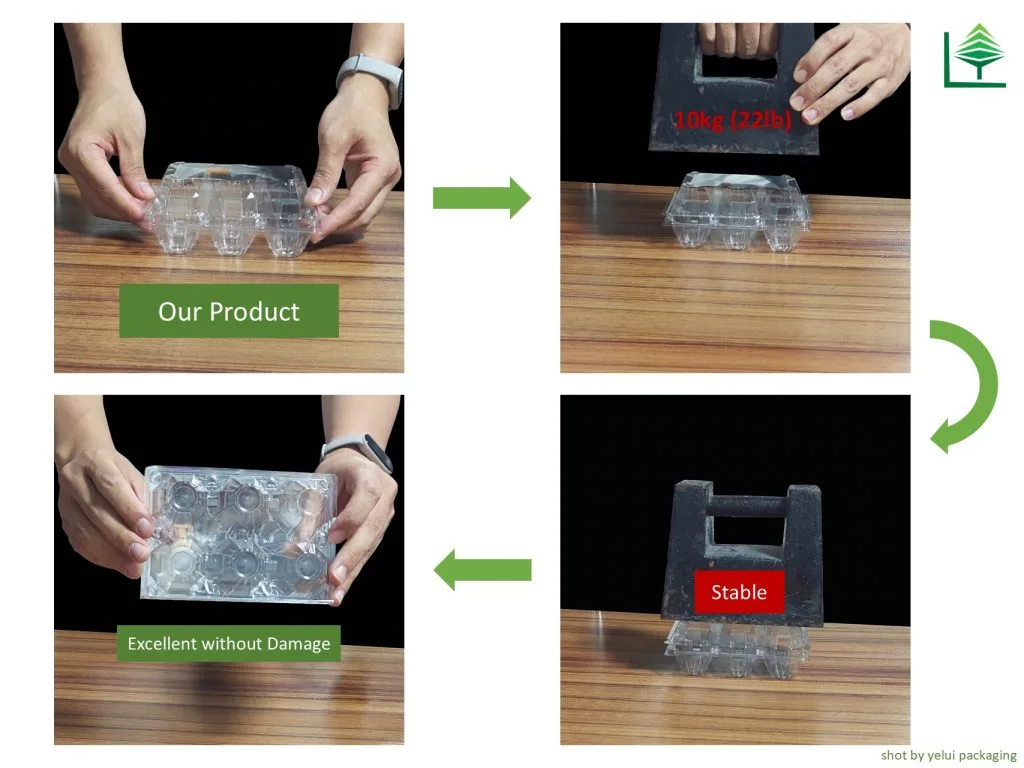
A hinge, a handle and a lid formed from the same PET sheet keep the whole unit in one stream, which is why a one piece clamshell is easier to qualify than a tray with a lidding film, a pad and a paper sleeve. Our introduction to what blister packaging is shows how sheet becomes a tray; the choice made at extrusion is the one the recycler inherits.
The label is a separate product
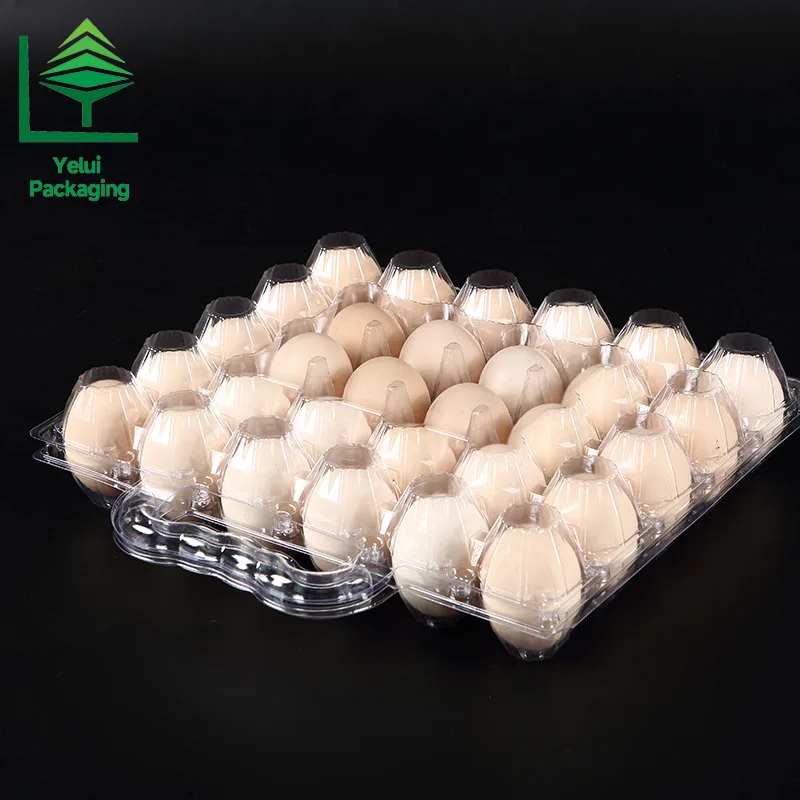
Brands rarely want an unprinted pack, and three elements travel with the tray: facestock, ink and adhesive.
RecyClass recommends labels and sleeves in the same polymer as the body, or a compatible material with limited coverage that does not hinder near infrared detection. Water releasable or water soluble adhesives are preferred, defined in its Design Book as adhesives releasing during washing at 40 °C without caustic soda. Adhesives that do not release leave the label stuck to the flake, and paper labels add fibre loss, where fibres survive washing and dull the resin. APR aligned guidance also flags full body sleeves, heavy direct printing and bleeding inks as detrimental. A small paper free PET label with a washable adhesive qualifies more easily than a sleeve wrapping the lid. Ask for the adhesive trade name and a wash off result, not a vague green claim.
Where regulation meets the drawing
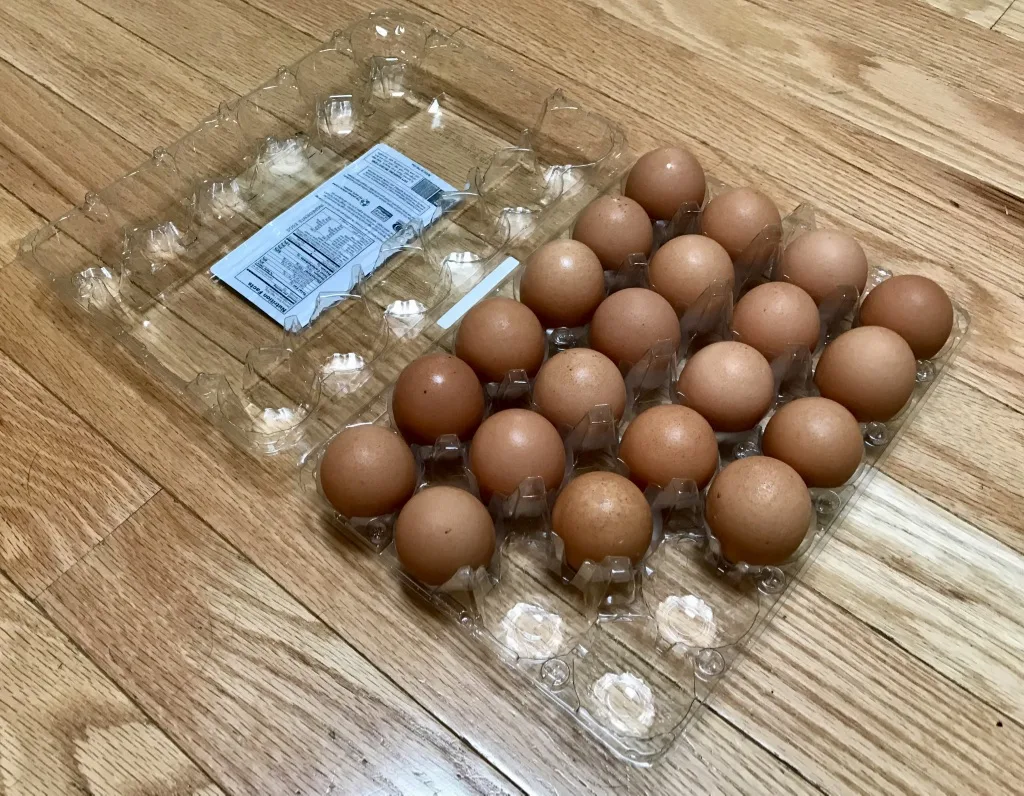
Design now carries legal weight. Regulation (EU) 2025/40, the PPWR, applies from 12 August 2026. Its recyclability grades are assessed by weight: A at 95 percent or more, B at 80 percent or more, C at 70 percent or more. Grade C is the minimum expected from 1 January 2030, and only A and B from 2038. Harmonised measurement standards are still being written, so a supplier claiming a grade should show the method behind it.
Article 7 sets a separate target: contact sensitive PET packaging other than single use beverage bottles needs at least 30 percent post consumer recycled content from 2030, rising to 50 percent from 2040. Only post consumer material counts; factory scrap and in house regrind do not. Food contact recycled PET in the EU also sits under Regulation (EU) 2022/1616, which authorises mechanical recycling of separately collected food grade PET and closed product loop schemes, each process evaluated by the European Food Safety Authority. Regulation (EC) 1935/2004, Regulation (EU) No 10/2011, Regulation (EC) 2023/2006 and 21 CFR Part 177 still apply. Some producer responsibility fees are modulated by recyclability. Our article on the EU packaging rules covers the calendar; here the drawing decides most of the score.
The collection caveat
Even a well designed tray is recycled only where thermoformed PET is collected. Bottles have a mature stream; trays are collected far less consistently. The Golden Design Rules note that PET trays have historically not been recycled at scale while describing new tray streams in Europe and North America. Treat any precise collection figure as an industry estimate unless it names a country, year and scheme.
That makes good design a hedge. A transparent, single polymer tray with a washable label is what any future tray stream can accept, and it can be reground into non food sheet where food grade recycling is unavailable. A dark multilayer tray with a paper label is rejected by both routes. The same logic applies to choosing between clear PET and molded pulp.
Seven lines for the request for quotation
Write the claim into the enquiry.
- Polymer and sheet. State PET, its share of the unit, intrinsic viscosity if known, and any laminated layer.
- Recycled content. Ask for the percentage, source and certificate chain behind the post consumer claim, with food contact authorisation named.
- Colour and additives. Clear uncoloured by default. List pigments and UV absorbers; confirm none is carbon black.
- Label, ink and adhesive. Name facestock, ink and adhesive; attach a wash off result at the agreed temperature.
- Other components. List lids, pads and seals with polymer and density; state which are removable before washing.
- Dimensions and weight. Give formed size, gram weight and units per carton; small items can be lost in sorting.
- Evidence. Request an APR or RecyClass assessment, the declaration of compliance and migration test reports.
Keep a signed golden sample, since recycled content and label suppliers change over a long programme. Our blister egg packaging FAQ collects the documentation questions buyers ask most.
Quick answers
Is a clear PET egg tray automatically recyclable?
No. PET is a recyclable polymer and clear uncoloured PET is the best starting point, but the pack must also be collected, sorted and washed in a real stream. Labels, adhesives, pigments and extra layers can move it from preferred to detrimental.
Does recycled content make a tray recyclable?
Separate claims. Recycled content describes what went into the sheet; recyclability describes what happens afterwards. PPWR Article 7 sets 30 percent post consumer content for contact sensitive PET from 2030, while the recyclability grades sit in Article 6. A tray can meet one and miss the other.
What is the single most useful change a buyer can make?
Specify one polymer for the whole pack and a washable label. Removing a mixed material lid, an opaque pigment or a non releasable adhesive improves sortability and flake quality, usually without new tooling. See the product range for standard formats.
Recyclability is not a badge pinned on a finished tray. It is a set of small decisions about polymer, colour, label, adhesive and size, free to change before a mould is cut and expensive afterwards. Write them into the enquiry and ask for evidence.
Kevin Zhao writes about materials, tooling and export documentation for the Yelui Packaging team.