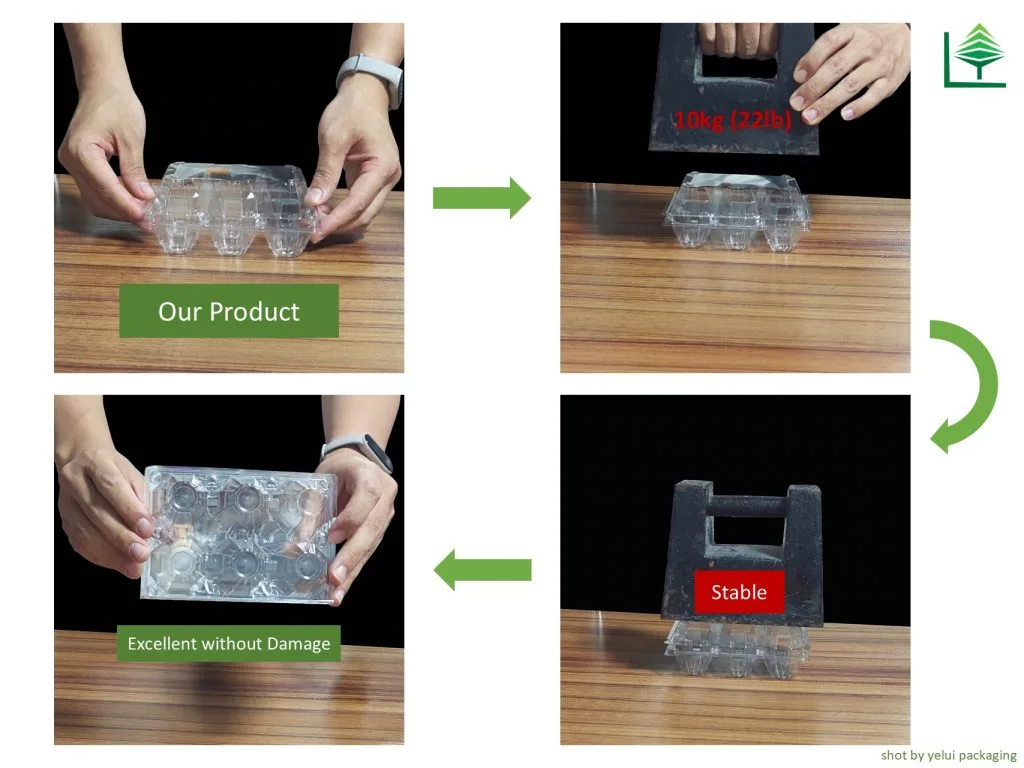
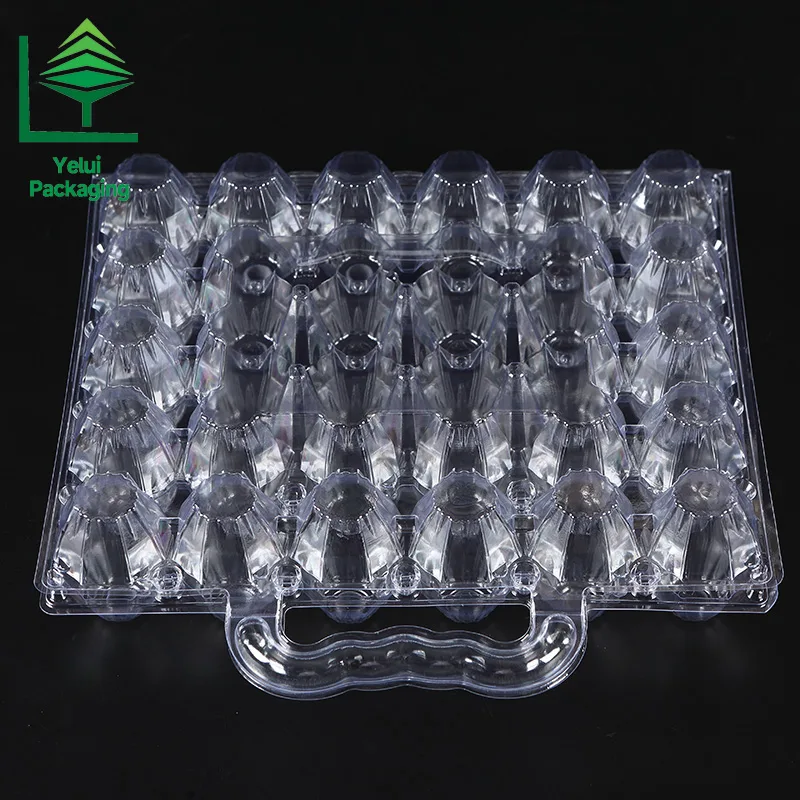
An egg pack that reaches the shelf with its lid ajar has already lost. Once the lid lifts, eggs walk out of their cells, one cracks, and store staff pull the whole tray. The closure is the cheapest feature on a clear PET egg tray and the one most likely to decide whether the pack survives the trip from the forming line to a fridge.
Three ways a closure fails
Closures rarely fail because the latch was too weak in absolute terms. The usual causes are a latch that never seats because the closing station has a fraction of a second to work, a latch that walks open under road vibration as close to 2 kg of eggs presses outward on the lid, and a hinge that cracks so the lid hangs loose even though the latch still works. Each has a different fix.
The three closure families you will be quoted
Nearly every egg tray closure on the market is one of three types, or a combination of them.
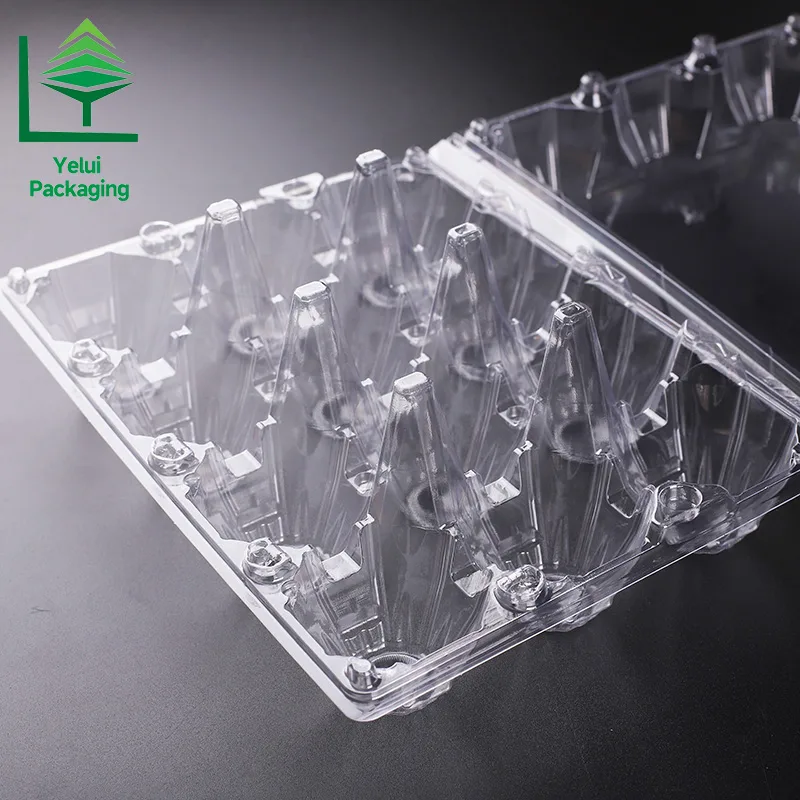
- Friction snap. A bead or rib on the lid flange drops into a matching groove on the base. It costs nothing extra to form and closes fast, so it is the default on high volume supermarket trays. The trade off is that holding force falls away as the flange flexes.
- Tab and slot. A positive lock: a tab on the lid passes through a slot in the base flange and hooks behind it. It resists vibration better than a friction snap, because the failure mode is tearing the tab.
- Secondary seal. A label, a band or a sleeve applied after closing. The only option that gives clear tamper evidence without changing the tool, and the only one that adds a per pack cost.
What the resin decides before the geometry does
Material choice sets the ceiling on what a closure can do. PET is stiff and gives a crisp snap, which is why it dominates clear egg trays. PET does not, however, make a good repeated flex hinge, so formed PET packs use a coined or scored hinge: a deliberately thinned, radiused crease that flexes a limited number of times. Thin it too much and you create a stress line that cracks on the first close; thin it too little and the lid springs back open.
Polypropylene behaves the other way round: its semi crystalline structure gives a true fatigue resistant living hinge, which is why packs meant to be opened many times lean towards PP even though PP is hazier than PET.
The numbers behind a snap latch
The governing quantity in a cantilever snap is not force, it is strain at the root of the arm. The usual working equation is strain = 1.5 x deflection x thickness / length squared, and four consequences of it matter in practice.
- Length is the strongest lever. Because length is squared in the denominator, a long thin arm survives where a short thick one cracks.
- Fillet the root. A sharp inner corner at the base of the tab is a stress riser; a radius of roughly half the wall thickness is the cheapest crack prevention on the part.
- Give the tab a lead in. Around 25 to 30 degrees lets the lid slide home instead of being slammed, and slamming is what shears hooks.
- Choose the retention angle for the duty. Around 40 to 50 degrees where the shopper will open the pack again, and 80 to 90 degrees where it must stay shut until torn open.
Published strain figures put polypropylene in the region of 5 to 8 percent and stiffer resins below that. A reclosable pack belongs well under the limit, because fatigue breaks it, not the first closing force.
Hinges: a scored crease versus a true living hinge
A polypropylene living hinge is a thin web, typically 0.25 to 0.5 mm at the formed gauge. It works because the melt flowing through the thin section orients the molecules along the hinge axis, and converters flex the hinge while the part is still warm to lock that orientation in. A well made PP hinge is quoted in the thousands of cycles. A PET pack has no equivalent; its scored crease is designed for a limited number of flexes.
So ask how thick the hinge is at the formed gauge and how many flexes it must survive, not how thick the sheet is. A weld line landing on a hinge axis or at the root of a snap arm also leaves a weak plane where strain is highest, so gate position belongs in the tooling review in our article on what a tooling quote really covers.
Tamper evidence without a second operation
A secure closure and a tamper evident closure are not the same thing. A secure closure keeps the pack shut through handling; tamper evidence shows a shopper that the pack has been opened. A friction snap can be perfect at its job and still tell the shopper nothing.
Thermoforming can build the evidence in without adding a step: perforated tear bridges formed into the flange so that opening destroys a bridge, interlocking locks that must be torn to release, or a frangible weld zone. Each breaks visibly on first opening and moves cost into the tool rather than the packing line.
How to test and specify a closure before you pay for a tool
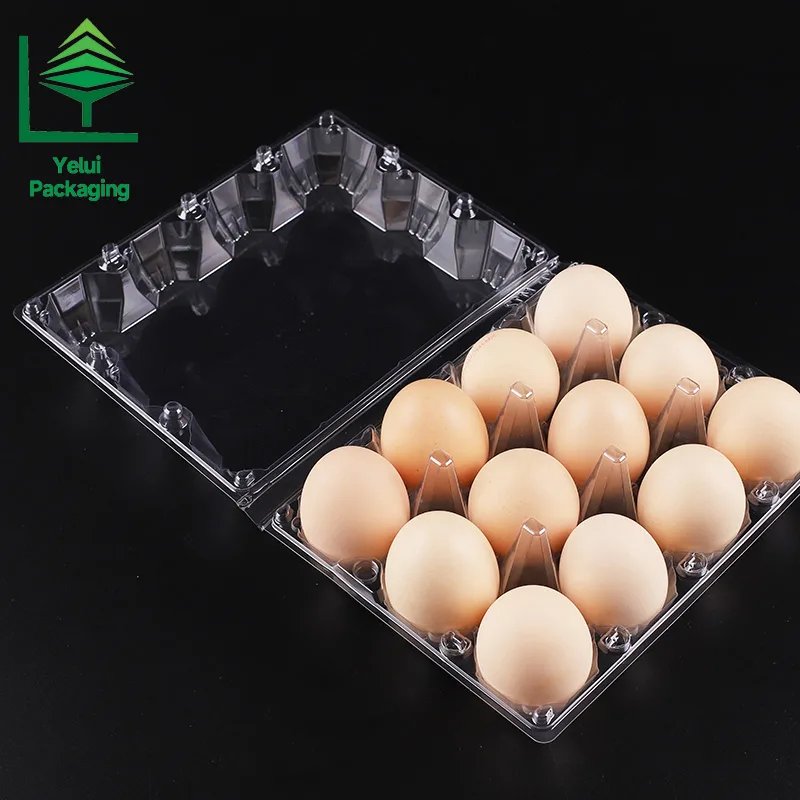
Five checks catch almost every closure problem while it is still cheap to fix.
- Open and close cycles. Run 20 to 50 cycles on real formed packs, then look for whitening at the hinge and at each tab root.
- Drop with the closure down. A filled pack dropped flat onto its lid from table height finds a latch that walks open.
- Vibration. A short run on a vibration table, or a pallet in a truck, then count the packs that came back open.
- Cold check. Repeat both after conditioning packs in a cold room, because stiffness and friction move with temperature.
- Closing trial at speed. Close a few hundred packs at line speed and count how many come back proud.
Then write six lines into the RFQ: the closure type; the target number of open and close cycles; whether tamper evidence is required; the formed hinge thickness or flex cycle target; the closing force window at your packing line; and how many filled packs must survive the drop and vibration routine.
Quick answers
Why does my egg carton lid pop open in transit but not in the warehouse?
Handling is the difference. A pack resting on a shelf sees almost no load, while a pallet on the road sees continuous vibration that works a latch loose a fraction of a millimetre at a time. Test filled packs with the closure facing down.
Can a clear PET egg tray have a true living hinge?
Not in the way a polypropylene pack can. PET is stiff and clear but does not flex repeatedly without cracking, so formed PET packs use a coined or scored crease designed for a limited number of flexes. If the pack must be opened many times, ask for the formed hinge thickness and a flex cycle target in writing.
How do I add tamper evidence without adding a labelling step?
Ask for the evidence to be formed into the tool: perforated tear bridges across the flange, interlocking locks that must be torn to release, or a frangible weld zone. Each breaks visibly on first opening and cannot be reset. For smaller runs a label across the lid line is cheaper.
A closure is a few grams of plastic and a few tenths of a millimetre of geometry, and it decides whether the eggs arrive in the cells you designed for them. Write the closure type, the cycle target and the acceptance test into the RFQ before the tool is cut, and the discussion moves from opinion to measurement. Start with our page on what blister packaging is, follow the forming steps in how a clear PET egg tray is made, or send us your cavity count and target market for a quote that includes the closure specification.
Cathy Zhou writes about packaging engineering and export procurement for the Yelui Packaging team.