
Ask three factories for the price of the same clear PET egg tray and the unit prices land within a few percent of one another. Ask for the tooling and the numbers run from a few thousand dollars to twenty thousand for the same drawing. The mold is the largest single payment in a custom packaging project and the line buyers benchmark least, yet it fixes the unit price for years.
Why the tooling line resists comparison
Two molds can be quoted from one drawing and differ in ways the quotation never states. The aluminium may be a cast plate or a billet cut on a large CNC. The cooling may be drilled channels or nothing at all, and the trim tool may travel with the mold or be quoted separately. Compare scope before you compare price.
What a complete tooling quotation contains
A forming mold for an egg tray is one part of a set. The full scope covers the forming tool itself, either a female cavity or a male core, depending on which surface has to hold the tighter tolerance. It covers the plug assist that pre stretches sheet into deep pockets so the walls do not thin out at the base, and the vacuum and pressure circuits that draw the sheet down.
It also covers cooling channels with plumbing to match your machine, plus trim tooling, either a steel rule die that cuts separately or a machined punch in the forming station. Stacking tooling, the trial run, the drawing package and spare inserts belong in the same document. Draft is the quiet variable: a cavity tool often manages with 1 to 3 degrees, a core tool needs 3 to 7, and every extra degree steals space from the next pocket.
Tool material: three families and the volume each one fits
Wood or MDF patterns cost least and arrive within days, holding a dozen parts before they degrade. They answer fit and form questions and little else.
Tooling board, epoxy composite and 3D printed tools carry a low volume of parts and take revisions well while a design is still moving, which makes them a sensible bridge when the volume forecast is uncertain.
Machined aluminium is where production tooling ends up. Its life is commonly put at 50,000 to 200,000 cycles, with milled tools quoted at 1 to 3 weeks and larger or more complex tools at 4 to 8 weeks. Cast aluminium covers very large tools, and steel is rarely justified in thin gauge work because forming pressures are low. Aluminium earns its place through heat rather than strength: values for cast aluminium plate sit near 142 W per meter kelvin, an order of magnitude above tooling board and resin composite, which is why the same part runs slower when the mold is not metal.
Cavity count: more parts per stroke, same cycle time
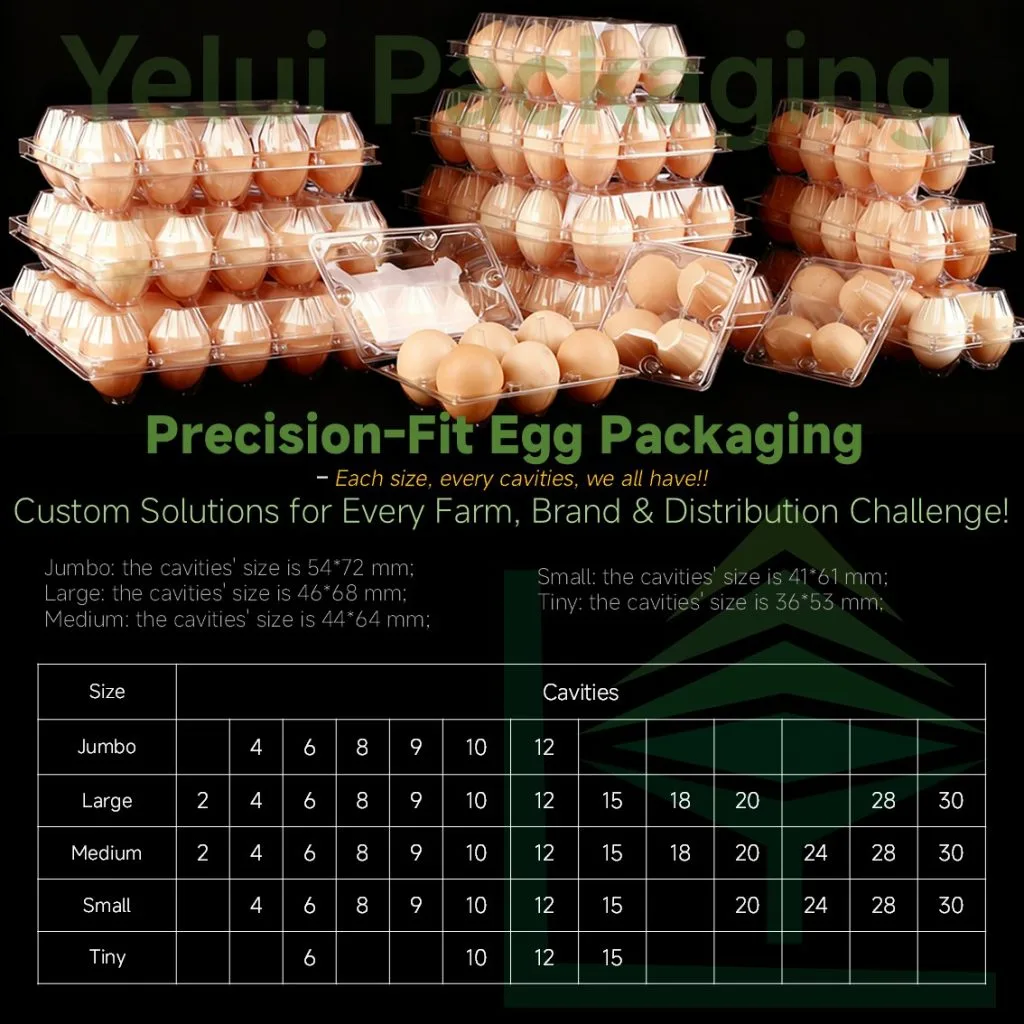
A press opens, forms and closes in the same time whether the tool carries 8 pockets or 16. A 16 cavity tool therefore returns twice the parts per stroke at the same cycle time, which makes cavity count the strongest lever on unit cost in thin gauge forming. Production tools for packaging commonly run 12 to 24 cavities, and lines cycle between roughly 3 and 15 seconds, so one extra cavity is worth real money over a year.
The ceiling comes from the forming area of your machine, the depth of the part, and the ability to spread heat and pressure evenly across the tool. Deep pockets consume more space and more sheet, so cavity count falls as draw depth rises. A very high cavity tool is also heavy and releases trays in large multiples, which suits a brand shipping by the container and hurts a packer who needs short runs. The market side of that trade is covered in our article on choosing a cavity count.
Cooling, trimming and the items buyers forget
Cooling is the quiet driver of cycle time. Industry sources put the gain from a water cooled aluminium mold at 30 to 50 percent against an air cooled block, at a tooling premium of 20 to 40 percent, a trade that usually repays itself inside the first year on a line that runs continuously.
Trimming is the second hidden cost. A steel rule die typically costs 500 to 3,000 dollars and cuts formed parts at up to 60 cycles per minute on a separate press. A machined punch built into the forming station costs more and holds tighter edges, so high volume leans towards the punch and a family of similar trays towards interchangeable rule dies.
Lead time: what five weeks actually contains
Tooling lead time for egg tray molds in China is commonly quoted at around five weeks after the deposit is paid and the final drawings are approved. Read that twice, because the clock starts at drawing approval rather than at the transfer. Those five weeks hold a DFM review, one or two rounds of drawing sign off, CNC machining and polishing, then assembly, trial and inspection. Samples usually fly to the buyer within a week of the trial, and the two things that move the date are changes requested after sign off and complexity such as pressure forming.
The amortisation maths that decides the case
Unit cost in thin gauge forming follows a short formula: material area cost divided by utilisation, plus mold cost divided by expected parts, plus machine rate multiplied by cycle time, plus trimming. The numbers that swing it most are sheet utilisation, where scrap commonly sits between 20 and 50 percent, and cycle time at machine rates of 40 to 100 dollars per hour.
Put a number on tooling recovery. Suppose a set covering the forming tool, trim die, stacking tool and one spare insert costs 12,000 dollars, and the tray sells for three years at about 300,000 units a year. Tooling then adds roughly 0.013 dollars to each tray. If the same tooling allows a gauge reduction from 0.45 mm to 0.40 mm, the material saving per tray is several times that recovery and repeats on every order.
Five clauses to settle before the deposit
- Ownership. Title transfers on final payment, with the drawing files.
- Exclusivity. Whether the factory can run your geometry for others.
- Storage and maintenance. Where the tool lives between orders.
- Modifications and wear. Price for a pocket change, an agreed definition of worn out, and the cost of a rebuild.
- Exit. What happens if you move the program, including crating and freight.
Quick answers
What does a clear PET egg tray mold cost?
Industry estimates for thin gauge packaging place a forming tool between roughly 2,000 and 15,000 dollars, with a steel rule trim die of 500 to 3,000 dollars on top, so a tool with a moderate cavity count, water cooling and integrated punching lands in the middle of that band. Figures borrowed from heavy gauge industrial vacuum forming quotes run higher and are not comparable.
How long does it take to get a custom egg tray mold?
About five weeks from drawing approval is the common figure from Chinese mold makers, plus a week or two for samples by air and one revision round. The most frequent cause of delay is not machining capacity but an unfinished drawing, because a change after sign off sends work back to the machine shop.
Does a higher cavity count always lower my unit price?
No. Cavity count lowers unit cost only when your machine can carry the tool, the pockets are shallow enough to share the forming area, and your order sizes absorb the output. A 24 cavity tool on a line that receives orders of 30,000 trays creates batches that sit in the warehouse.
A mold is a capital asset with a maintenance schedule, a life expectancy and an exit plan, and the quotation is only its first page. Our products section lists the sizes and cavity counts we already tool, and our blister egg packaging FAQ covers the questions that come up before a tooling order.
Cathy Zhou writes about packaging engineering and export procurement for the Yelui Packaging team.