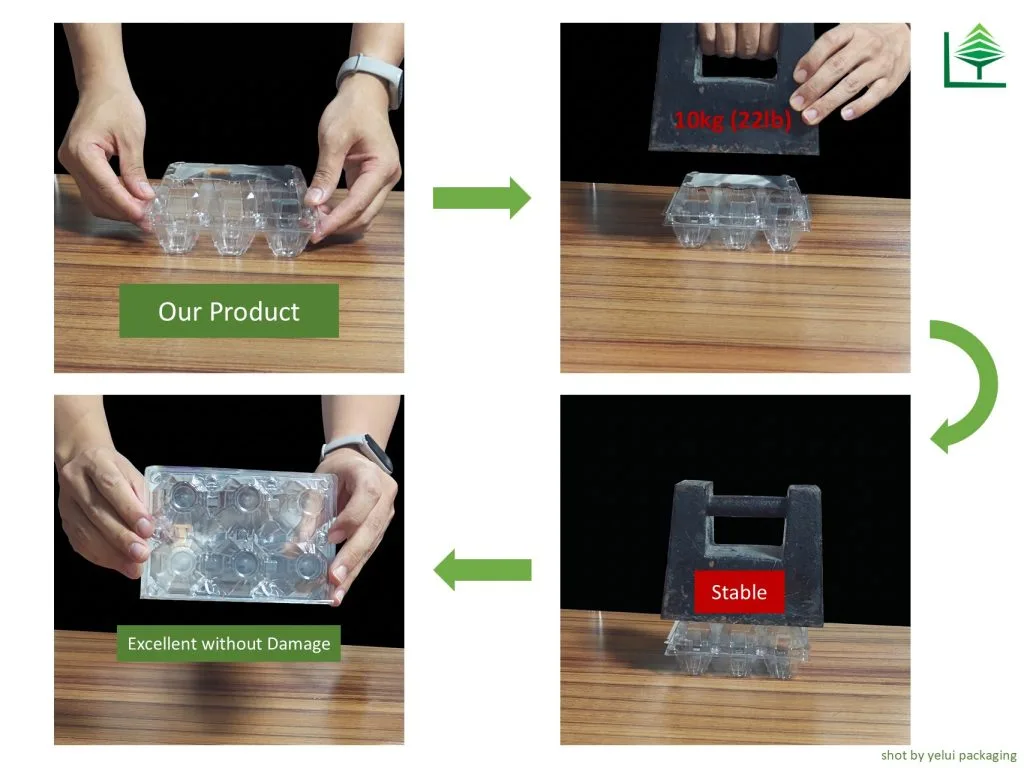
Since 12 August 2026, a package sold in the European Union has had to satisfy one regulation instead of twenty seven national readings of a directive. Regulation (EU) 2025/40, known as PPWR, replaced rules that had stood for almost thirty years. For egg packers and importers who buy clear PET trays, the date that matters most in procurement is not the one that already passed. It is 1 January 2030, when contact sensitive PET packaging placed on the EU market must contain at least 30 percent recycled material. That number changes what you buy and what paperwork travels with the container.
Does an egg tray really count as packaging?
Yes, and the regulation is deliberately broad. It covers every material and format, including packaging that arrives with imported goods, transport packaging and packaging used by online sellers. A clear PET tray that holds eggs for retail is sales packaging in direct contact with food, which the regulation treats as contact sensitive packaging.
The exemptions are narrow: immediate packaging for medicines and medical devices, packaging for infant food, dangerous goods, and a few materials such as cork or ceramic. One detail does help designers: a plastic component that stays below 5 percent of the total packaging unit by weight is left out of the recycled content targets, so a simple mono material structure is easier to defend than a multi material one.
What has applied since 12 August 2026
- Heavy metals. Lead, cadmium, mercury and hexavalent chromium together must stay at or below 100 mg per kg across every component: the tray, the carton, the ink, the adhesive and the label. One non compliant part makes the whole unit non compliant.
- PFAS in food contact packaging. Limits apply to each single non polymer PFAS at 25 parts per billion, to their sum at 250 parts per billion, and to total fluorine at 50 parts per million. Greaseproof and non stick coatings are the usual source.
- Technical file and declaration of conformity. The manufacturer or importer must hold a conformity assessment file, sign a declaration for each packaging type and keep the file for at least five years. Authorities and customs can ask for it.
- Extended producer responsibility. Anyone who first places packaging on the market of a member state registers there, reports volumes and pays the collection and recycling fee. A seller outside the EU appoints an authorised representative.
One warning worth passing to trading partners: an EPR registration number is not proof of compliance. Inspections ask for test reports, a technical file and the signed declaration.
The recycled content deadline: 1 January 2030
Targets are set per packaging category and calculated as an average per manufacturing plant and year. Only post consumer waste counts, so factory scrap and pre consumer regrind do not help. The recyclate must also be recovered from waste collected inside the EU, or in a country whose collection rules are recognised as equivalent, and the Commission was due to publish the calculation methodology by 31 December 2026.
| Packaging category | From 2030 | From 2040 |
|---|---|---|
| Contact sensitive packaging made mainly from PET | 30 percent | 50 percent |
| Other contact sensitive plastic packaging | 10 percent | 25 percent |
| Single use plastic beverage bottles | 30 percent | 65 percent |
| Other plastic packaging | 35 percent | 65 percent |
A clear PET egg tray sits in the first row, because PET is its major component and it touches food. Pulp cartons sit outside this article altogether: they are not plastic packaging, though they still face the recyclability and labelling duties.
Where the recycled PET has to come from
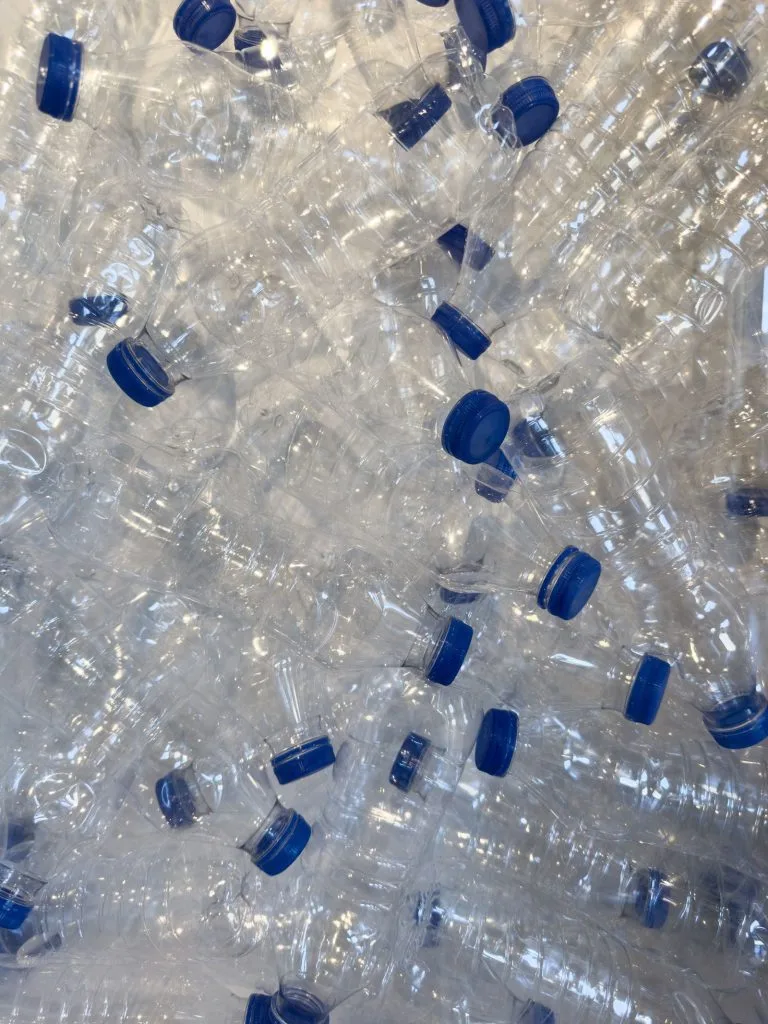
This is the part that turns a design question into a supply question. Recycled plastic in food contact applications is governed separately by Regulation (EU) 2022/1616, and only authorised recycling processes may supply it. In practice the main route is mechanical recycling of separately collected post consumer PET, together with closed product loops.
The consequence for trays is competition for the same food grade flakes that bottle makers buy, because beverage demand already takes most of the available mechanical volume. Industry estimates put the premium over virgin resin in a range that swings with region and contract length, so treat any rate you are quoted as a starting point and secure volume early rather than in 2029.
Three checks separate a serious offer from a hopeful one. Which authorised process did the flakes come from? Which chain of custody model backs the percentage, whether physical segregation, controlled blending or mass balance, and which certificate such as RecyClass or ISCC PLUS carries it? And will the figure appear in the bill of materials and the declaration of conformity rather than only in an e mail?
Recyclability grades reward the plain tray
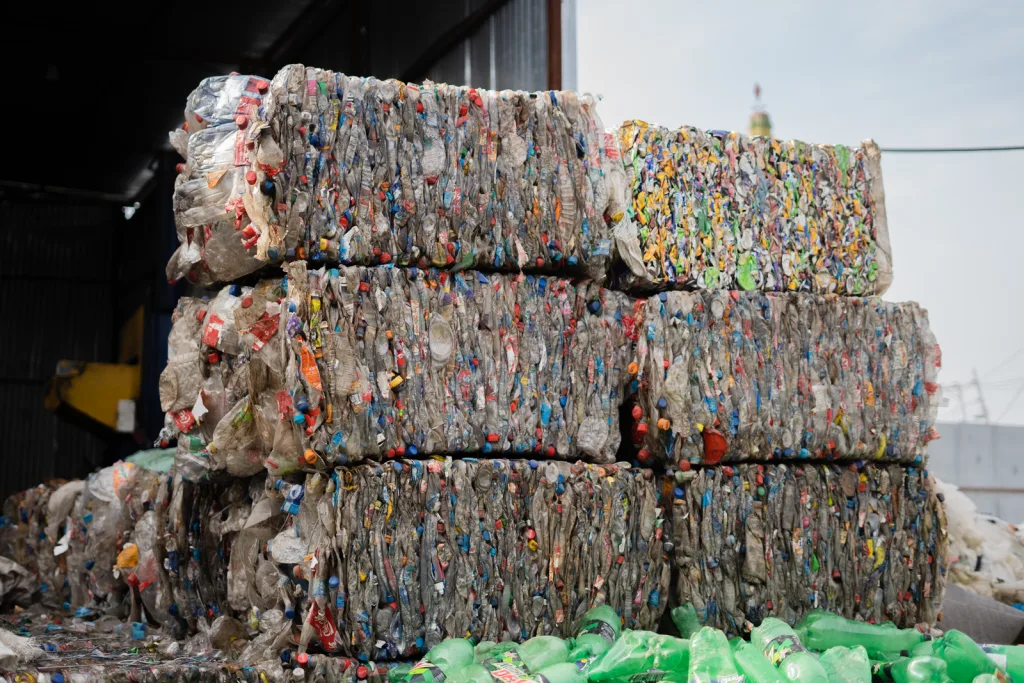
From 1 January 2030, packaging must meet a design for recycling grade of A, B or C, which correspond to recyclability scores of 95, 80 and 70 percent. Anything below 70 percent cannot be placed on the market. From 2038 only grades A and B remain. Transport, grouped and e commerce packaging must also keep empty space at or below 50 percent from 2030, and designs that inflate apparent volume such as false bottoms are prohibited.
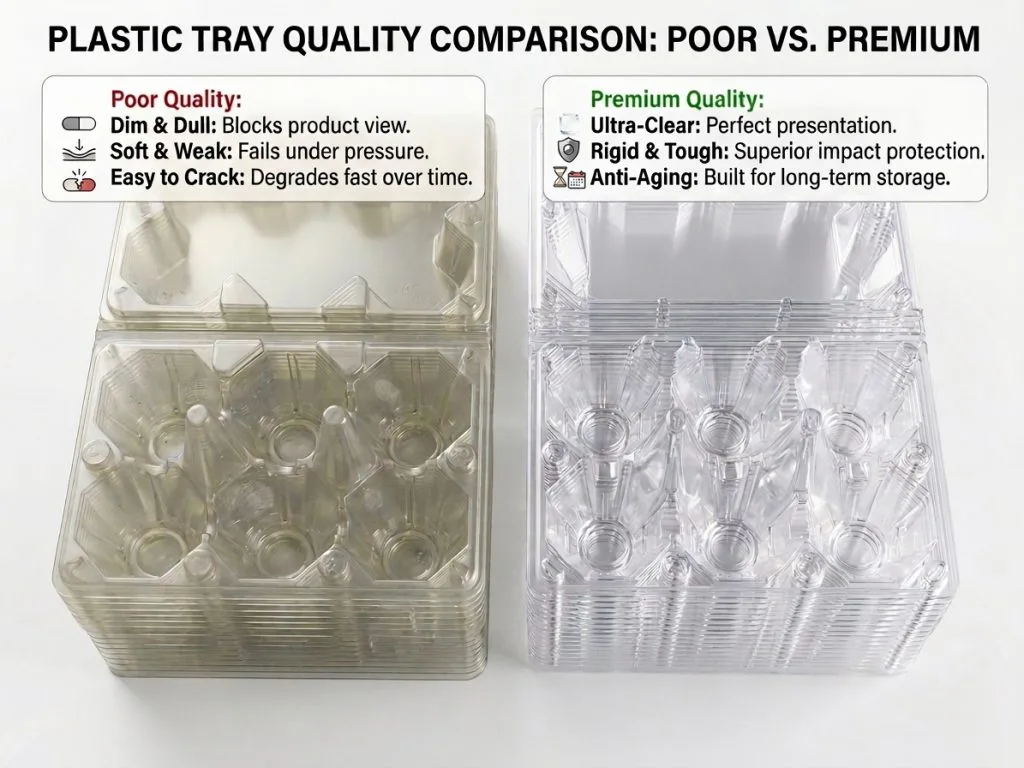
A clear PET tray already starts in a strong position because it is a single material. What pulls a tray down the grades is decoration: full body sleeves that hide the material, adhesives that leave residue, dark masterbatch such as carbon black that sorting equipment cannot detect, and laminates that fuse polymers together. For branding, print or emboss the tray directly instead of adding a second material layer.
A purchase order checklist for the years ahead
- Write a recycled content clause naming the percentage, the chain of custody model and the certification, with evidence for each shipment.
- Ask for a resin and food contact declaration under Regulation 1935/2004, with migration testing under Regulation (EU) 10/2011 where applicable.
- Collect test reports for heavy metals and, for food contact packaging, for PFAS and total fluorine.
- Confirm the supplier can support the technical file and a declaration of conformity you can pass down the chain.
- Choose mono material designs, avoid carbon black, and plan for the harmonised material marking required by 12 August 2028.
- Register for extended producer responsibility in each market where you are the producer, or appoint an authorised representative.
Quick answers
Which egg trays must contain 30 percent recycled plastic?
Contact sensitive packaging made mainly from PET, which covers clear PET egg trays and clamshells used for retail eggs, needs at least 30 percent post consumer recycled content from 1 January 2030. Trays moulded from other plastics face a 10 percent floor, and moulded fibre cartons fall outside the recycled content article because they are not plastic packaging. More definitions sit in our blister and egg packaging FAQ.
Is recycled content required in 2026 as well?
No. The duties already live since 12 August 2026 concern heavy metals, PFAS limits for food contact packaging, the technical file, the declaration of conformity and EPR registration. The recycled content floor begins on 1 January 2030. Treat 2026 as the year to build documents and 2030 as the year the material itself must change.
Can a factory in China supply compliant recycled PET egg trays?
Yes in principle, because the rule targets the origin and the documentation of the recyclate rather than the location of the plant. The material must be post consumer, collected in the EU or in a country with equivalent rules, and for food contact it must come from an authorised recycling process. Contract volume early, ask for the traceability document with each shipment, and check that the percentage on the certificate matches the number in the declaration.
None of this requires exotic engineering. A clear PET tray is one of the easier packages to recycle and to document, precisely because it is one material and needs no inks or fibres that contaminate the stream. The hard work sits in contracts: know the grade you must hit, know where the flakes come from, and write both into the order. To see the production side of the same subject, our guide to blister packaging follows resin from sheet to finished tray, and the product catalog lists the cavity counts we run in clear PET. Send an inquiry with your market and your egg size and we will tell you plainly what we can certify now and what we can commit to by 2030.
Cathy Zhou writes about packaging compliance and export practice for the Yelui Packaging team.